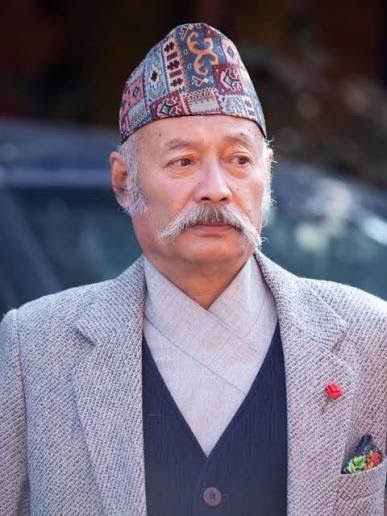
Madhu Bajra Bajracharya is an ayurvedic doctor who was trained by his father, the late Mana Bajra Bajracharya (d. 2001). They descend from a famous lineage of Buddhist priests, as Mana recounts in his autobiography:
By caste, we are Shakya related to the Shakya of Kapilavastu, the birthplace of Lord Gautama Buddha. During the medieval period, following the principles of Bajrayana, the third advanced stage of Buddhism (following Hinayana and Mahayana), our ancestors received the consecration of Bajrayana. This consecration bestows the title of Bajracharya. To have this title, one must follow the principles of the “Heruka Chaka Samvara Tantra.” Those with the title of Bajracharya are the priests of the Newari Buddhists, one of the ancient inhabitants of Kathmandu Valley.
In 1937, I received my formal initiation as a Bajracharya, which I needed to be a member of the Bihara. In 1944, I received my consecration as Bajrayana, which I needed to be an authorized Bajracharya. In 1945, I married with Gyani Devi Bajracharya. Marriage is essential for Bajrayana practice. We have a son and four daughters.
The collection
According to Madhu Bajra Bajracharya, his father learnt Sanskrit and collected manuscripts of medical works. He became known locally as a collector and was consequently offered manuscripts on many other subjects. As a result, the current collection includes not only medical works but a wide variety of material ranging from grammar and philosophy to narrative, devotional and astrological texts.
Many years ago, Madhu Bajra Bajracharya compiled a handlist of the collection, which he kindly sent to Dominik Wujastyk in private correspondence. This handlist indicates that the collection contains many hundreds of manuscripts, at least forty-four of which are on medicine.
I visited Madhu Bajra Bajracharya’s house, where he kindly showed me the collection. It is kept in three large metal cabinets, with each manuscript wrapped in cloth and tied with string. Unfortunately, the manuscripts are currently piled up and jumbled together, so it is impossible to find any particular item without unpacking the cabinets.
A palm-leaf Carakasaṃhitā
Fortunately, during my visit Madhu Bajra Bajracharya managed to find a palm-leaf manuscript of the Carakasaṃhitā, which is recorded as the first entry in the vaidyaśāstra section of his handlist. It is incomplete and undated, but judging from the condition of the palm leaves and the style of writing, it looked very old to me, possibly earlier than the fifteenth century. This manuscript left me with the impression that the collection likely holds some very old and valuable material.
Texts and experience
I had the opportunity to talk to Madhu Bajra Bajracharya about the future of the collection. He feels that his children are not particularly interested in it, and he himself no longer needs it, now that he has fifty years of experience as an ayurvedic doctor. He told me that texts are useful for those learning Ayurveda because they provide general information, but that the most valuable knowledge comes from practising Ayurveda, through which one learns how to diagnose and treat people according to their peculiarities. Doctors, he said, need to treat people rather than illnesses; experience provides knowledge of both, whereas texts are limited to the latter. His father tried to address this issue by recording notes in diaries about specific cases. Madhu Bajra Bajracharya showed me these diaries, which are written in Nepāl Bhāṣā, and said they are the only books on Ayurveda that he now consults.
The future of the collection
Although the manuscript collection has little practical value for him, Madhu Bajra Bajracharya recognises its importance for preserving the history and heritage of Nepal, and he would like the collection to be properly housed and cared for after his passing. To this end we discussed digitisation initiatives, such as the British Library’s Endangered Archives Programme. Digitisation may help to safeguard the contents, but one would hope that the manuscripts themselves eventually end up in the care of a professional library that can preserve them for future generations.
The handlist does not mention a manuscript of the Suśrutasaṃhitā, but Madhu Bajra Bajracharya believes there is one in his collection. We therefore hope to return next year, with more time in hand, to unpack the cabinets and search the collection more thoroughly.
Web sources
- Mana Bajra Bajracharya, Ayurveda in Nepal
- Endangered Archives Programme, British Library