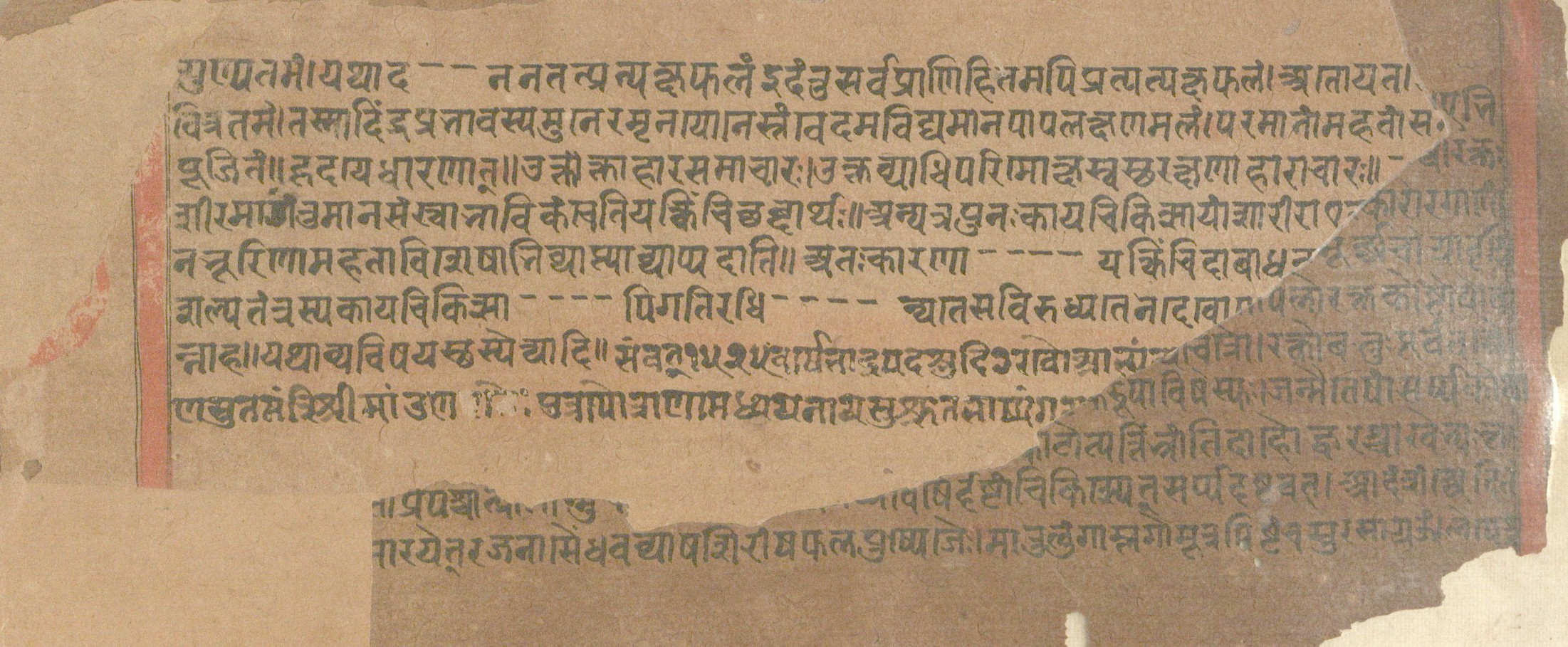
Jekyll2026-10-25T01:51:00+00:00https://sushrutaproject2.github.io/feed.xmlThe Compendium of Suśruta in Time and SpaceA project on the history of medicine at the University of Alberta, studying the evolution of the Compendium of Suśruta between the ninth and nineteenth centuries.Dominik WujastykA Visit to the Āmer Śāstra Bhaṇḍār, Jaipur2026-10-12T03:30:00+00:002026-10-12T03:30:00+00:00https://sushrutaproject2.github.io/blog/2026/visit-to-the-Amer-Sastra-BhandarOn 12 October 2026, Jason Birch and I visited the Āmer Śāstra Bhaṇḍār in Jaipur, a Digambara Jain manuscript library. Our aim was to see a manuscript of the Suśrutasaṃhitā that had been recorded there in the mid-twentieth century.
The library
The Āmer Śāstra Bhaṇḍār has been housed in several places in Rajasthan over its history. It was formerly known as the Bhaṭṭāraka Devendrakīrti Bhaṇḍār and was originally kept in the Digambara Jain temple of Neminātha at Amber. It was later moved to the Mahāvīra Jaina Bhavana in Jaipur, and then to Śrī Mahāvīrjī.
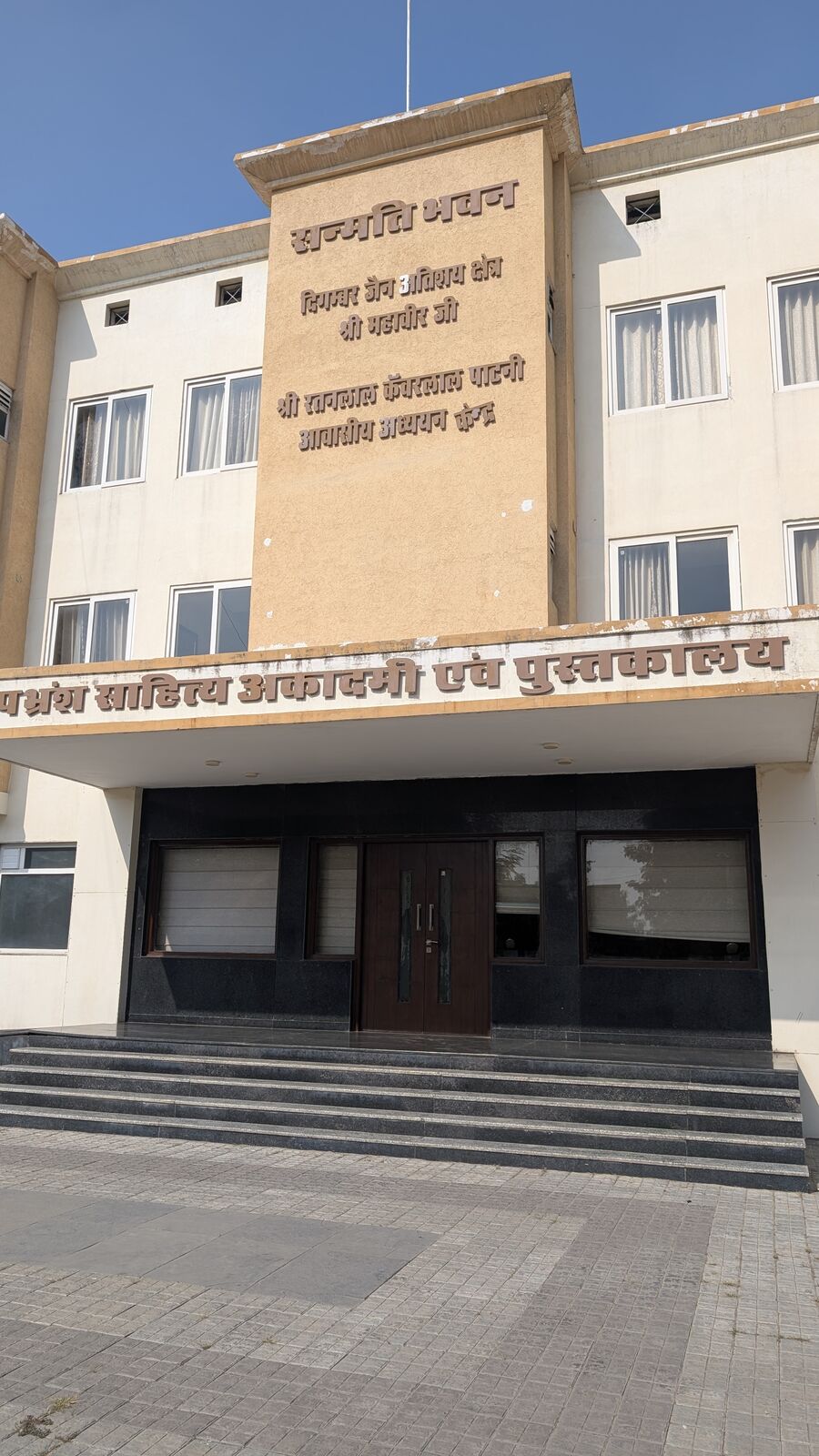
Today the collection is hosted by the Apabhraṃśa Sāhitya Akādamī evaṃ Pustakālaya (the Apabhraṃśa Literary Academy and Library), an institution of the Digambar Jain Atishay Kshetra Shri Mahaviraji dedicated to teaching Apabhraṃśa, the language of many Jain literary and religious works. The address is Block B, Malviya Nagar, Jaipur, Rajasthan 302017, not far from Jaipur’s airport.
The Sanmati Bhavan, home of the Apabhraṃśa Sāhitya Akādamī evaṃ Pustakālaya, Malviya Nagar, Jaipur.
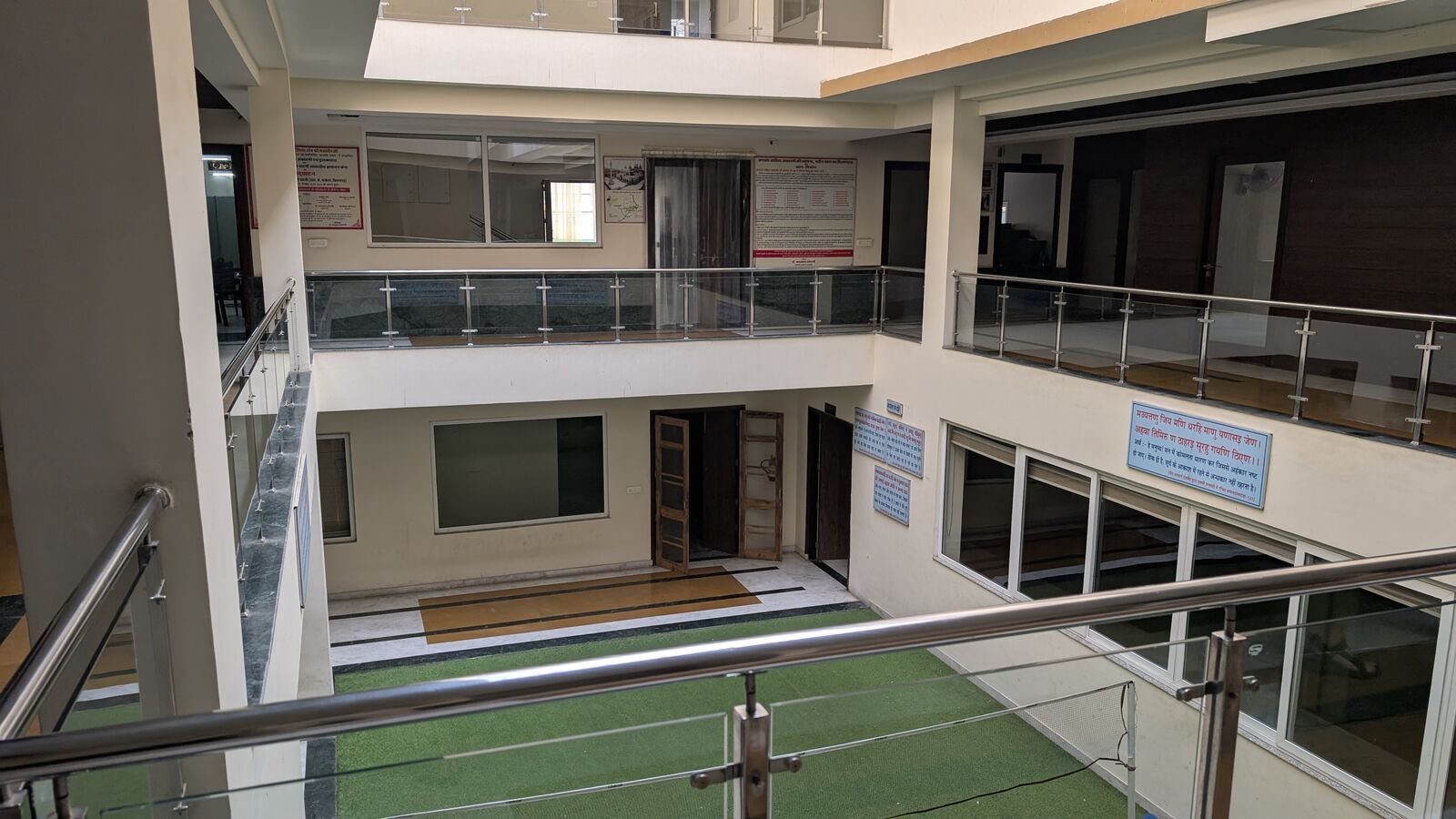
Inside the Akādamī.
Catalogues and studies
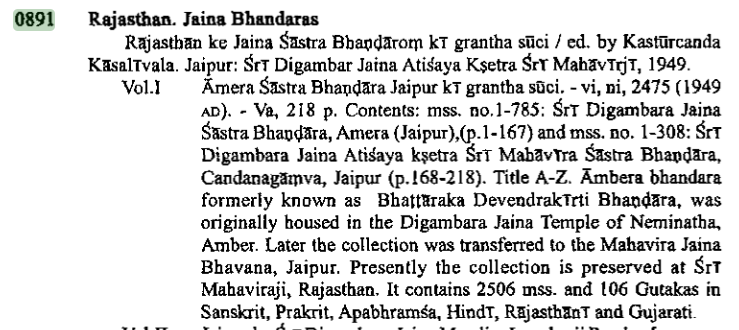
The library was catalogued by Kastūrcanda Kāslīvāl in 1949, in the first volume of his Rājasthān ke Jaina Śāstra Bhaṇḍārom kī grantha sūcī (Biswas, no. 0891, vol. 1):
The entry for Kāslīvāl's 1949 catalogue in Biswas's bibliography of Indic manuscript catalogues.
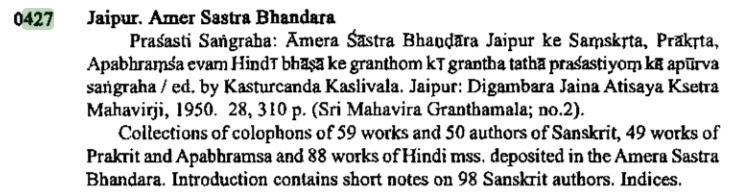
A year later Kāslīvāl published a companion volume, the Praśasti Saṅgraha, collecting the colophons (praśasti) of manuscripts in the same collection (Biswas, no. 0427):
The entry for Kāslīvāl's Praśasti Saṅgraha (1950) in Biswas's bibliography.
Important contemporary information on the library, its contents and its history is given by Ulrich Timme Kragh:
Kragh, Ulrich Timme, and Abhishek Jain (2019), ‘A Preliminary Study on the Indian Grammar Manuscripts of the Āmer Śāstrabhaṇḍār in Jaipur’, Przegląd Orientalistyczny 2019/1: 3–21.
The Suśrutasaṃhitā manuscript
Kāslīvāl’s list (p. 154) records a single manuscript of the Suśrutasaṃhitā, containing only the Kalpasthāna, in 21 folios:
Kāslīvāl's entry for the Suśrutasaṃhitā manuscript.
The entry reads:
भाषा-संस्कृत। पत्र संख्या २१. साइज १०॥×४॥ इञ्च। लिपि संवत् १७०२. केवल कल्पस्थान ही है।
That is: language Sanskrit; 21 folios; size 10½ × 4½ inches; copied in Saṃvat 1702 (1645/46 CE); contains only the Kalpasthāna.
Our visit
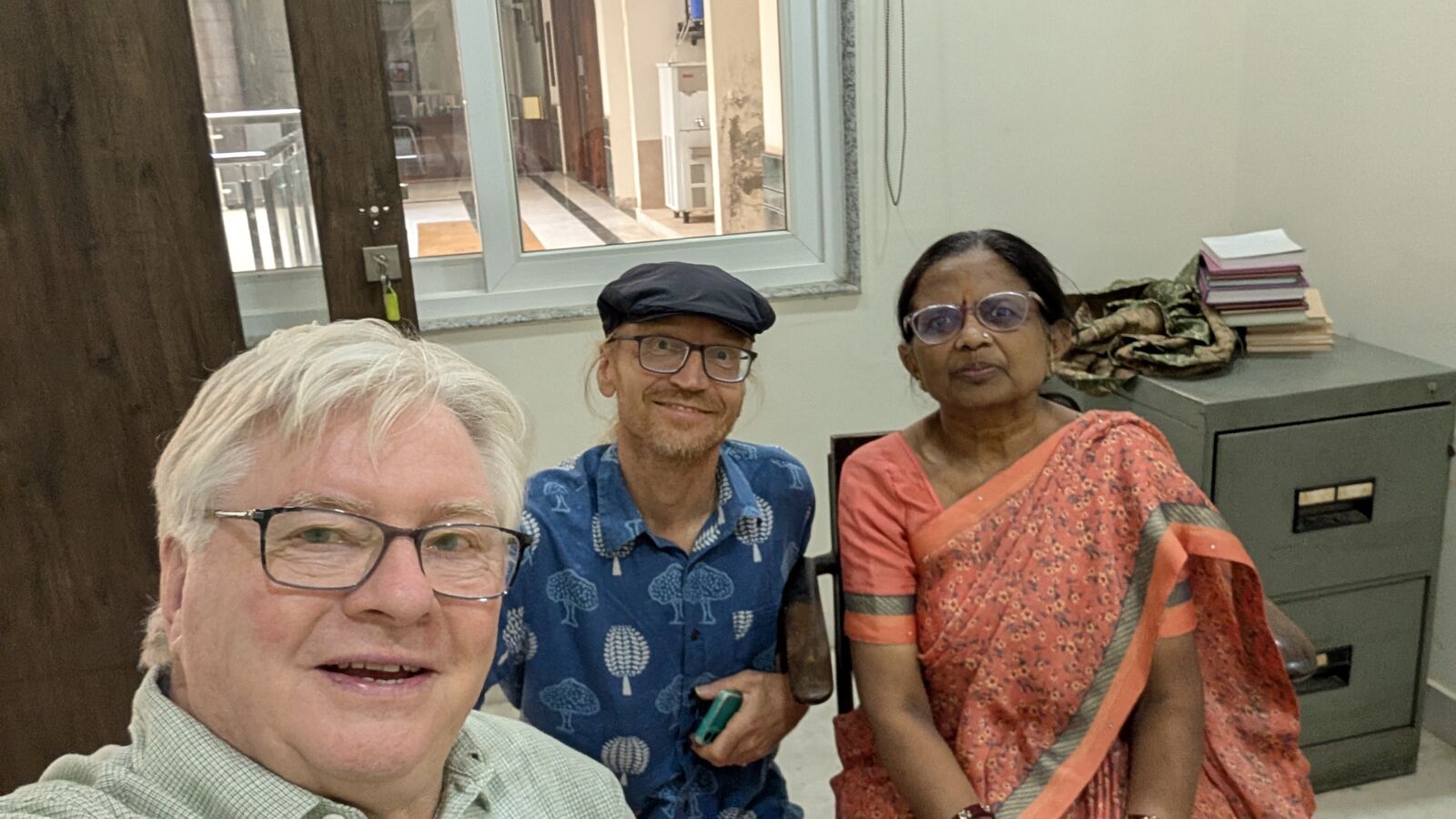
At the library we met the Director, Smt. Shakuntala Jain, who received us kindly.
L–R: Dominik Wujastyk, Jason Birch, Smt. Shakuntala Jain.
Unfortunately, the manuscript recorded in Kāslīvāl’s catalogue is no longer in the collection. Smt. Jain produced a handwritten list of the Āyurvedic titles held in the library, and the Suśrutasaṃhitā was not among them. We were not able to photograph the list. It seems, sadly, that MS Jaipur Āmer Śāstra Bhaṇḍār Kāslīvāl 154 was lost at some time between 1950 and 2026.
We thank Smt. Shakuntala Jain for her welcome and for her help in searching the collection.
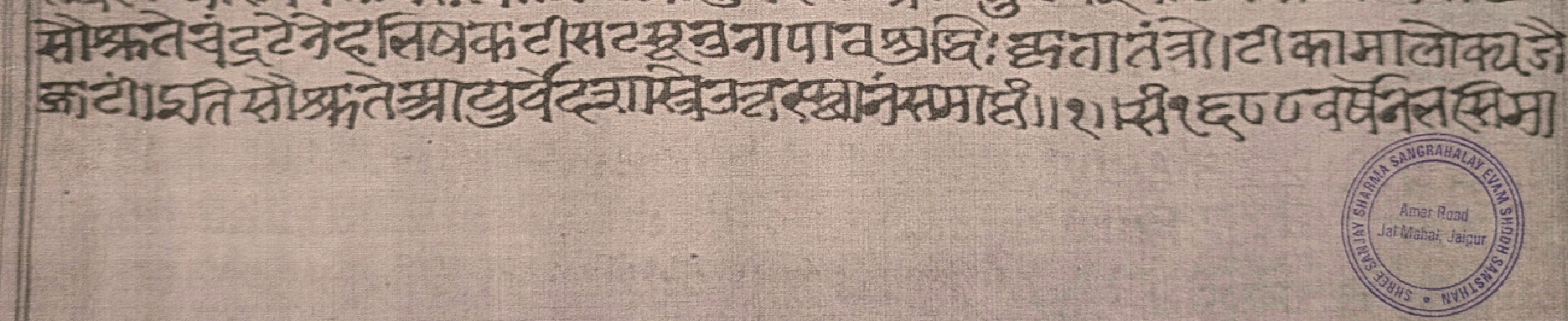
]]>Dominik WujastykCandraṭa’s editing of the Suśrutasaṃhitā, updated October 20262026-10-12T00:00:00+00:002026-10-12T00:00:00+00:00https://sushrutaproject2.github.io/blog/2026/candrataUpdate of 2026: new example from the Sanjay Sharma Museum, Jaipur
The reading “tantro” for “tantre” is probably the scribe’s mistaken inclusion of the following daṇḍa in the syllable: तन्त्रे॥ -> तन्त्रो।
Original post of September 2024
Candraṭa was a Sanskrit author on medical topics who lived in the period 900-1050 CE (Meulenbeld, 1999, pp. IIA: 122–125). He is perhaps best known for writing a commentary on his father Tīsaṭa’s treatise, Cikitsākalikā. But Candraṭa wrote several other works, and of most relevance to our project is his “Editorial Corrections to the Suśruta text” (Suśrutapāṭhaśuddhi). Candraṭa himself said that he created this work, in a verse included at the end of his commentary on the Cikitsākalikā:
cikitsākalikāṭīkāṃ yogaratnasamuccayam/
suśrute pāṭhaśuddhiṃ ca tritayaṃ candraṭo vyadhat//
“I created the following three works: the commentary on the Cikitsākalikā, the Yogaratnasamuccaya and the Suśrutapāṭhaśuddhi (`Correction of the Text of the Suśruta’).”
An authorial statement is also found in some colophons of the Suśrutapāṭhaśuddhi itself, as is shown on f. 59 of MS London IOLR Taylor 1842 (Eggeling catalogue no. 2646):
“The correction of readings (pāṭhaśuddhi) in the treatise of Suśruta was done by Candraṭa the son of the doctor Tīsaṭa, after studying the commentary of Jejjaṭa.”
Another MS that has the same statement is MS Bikaner Anup 4391 (Kunhan Raja Catalogue p. 337):
In an undated manuscript of the Suśrutasaṃhitā, śārīrasthāna, from Kurukṣetra, we find the same text in a section colophon, but in a slightly expanded form (MS Kurukṣetra Jawaharlal Nehru Library 19786, f. 78v):
“The sūtrasthāna has been completed, with the nidāna and śārīra sthānas, and I will explain the fourth, the cikitsāsthāna. The Correction of Readings (pāṭhaśuddhi) in the treatise of Suśruta was done by Candraṭa the son of the doctor Tīsaṭa, after studying the commentary of Jejjaṭa.”
The Kurukṣetra colophon above has the extra initial statement, “I will explain (vakṣyāmi).” It is not clear whose voice this is. Is it the scribe? But vakṣyāmi is normally an authorial expression, where a scribe would be more likely to say something like likhyate mayā. The second statement, which is the same as that of the London MS, is more straightforward: Candraṭa wrote The Correction of Readings. This sounds like a statement by Candraṭa himself. However, this raises the question of why the statement appears at the end of the Kurukṣetra manuscript, which contains only the Suśrutasaṃhitā, and does not include Candraṭa’s work. However, it is definitely of interest that the scribe of the Kurukṣetra manuscript was aware of Candraṭa’s work and thought of it as a relevant reference to raise in the context of a manuscript of the Suśrutasaṃhitā. This means that several centuries after Candraṭa, the Suśrutasaṃhitā was thought of as a work that he had corrected.
Bibliography
Aufrecht, T. (1864). Codices Sanscriticas Complectens (Issue 8.1). E Typographeo Clarendoniano.
BibTeX
@book{aufr-1864,
  author = {Aufrecht, Theodor},
  publisher = {E Typographeo Clarendoniano},
  title = {Codices Sanscriticas Complectens},
  year = {1864},
  address = {Oxford},
  note = {\cite[\#0767]{bisw-1998}},
  number = {8.1},
  series = {Catalogi codicum manuscriptorum bibliothecæ Bodleianæ}
}
Meulenbeld, G. J. (1999). A History of Indian Medical Literature. E. Forsten. http://n2t.net/ark:/13960/t4qk6558q
@book{meul-hist,
  author = {Meulenbeld, Gerrit Jan},
  publisher = {E. Forsten},
  title = {A History of Indian Medical Literature},
  year = {1999},
  address = {Groningen},
  isbn = {9069801248},
  url = {http://n2t.net/ark:/13960/t4qk6558q},
  volumes = {5}
}
]]>Dominik WujastykA Visit to the Kaiser Library, Kathmandu2026-10-10T03:15:00+00:002026-10-10T03:15:00+00:00https://sushrutaproject2.github.io/blog/2026/visit-to-the-Kaiser-LibraryOn 30 September 2026 we visited the Kaiser Library in Kathmandu. The library is the home of MS Kathmandu KL 699, the palm-leaf manuscript of the Suśrutasaṃhitā copied in 878 CE, which has been at the centre of the Suśruta Project’s work since its first phase. The purpose of the visit was to meet the library’s staff, to see the manuscript, and to propose a collaboration on its publication.
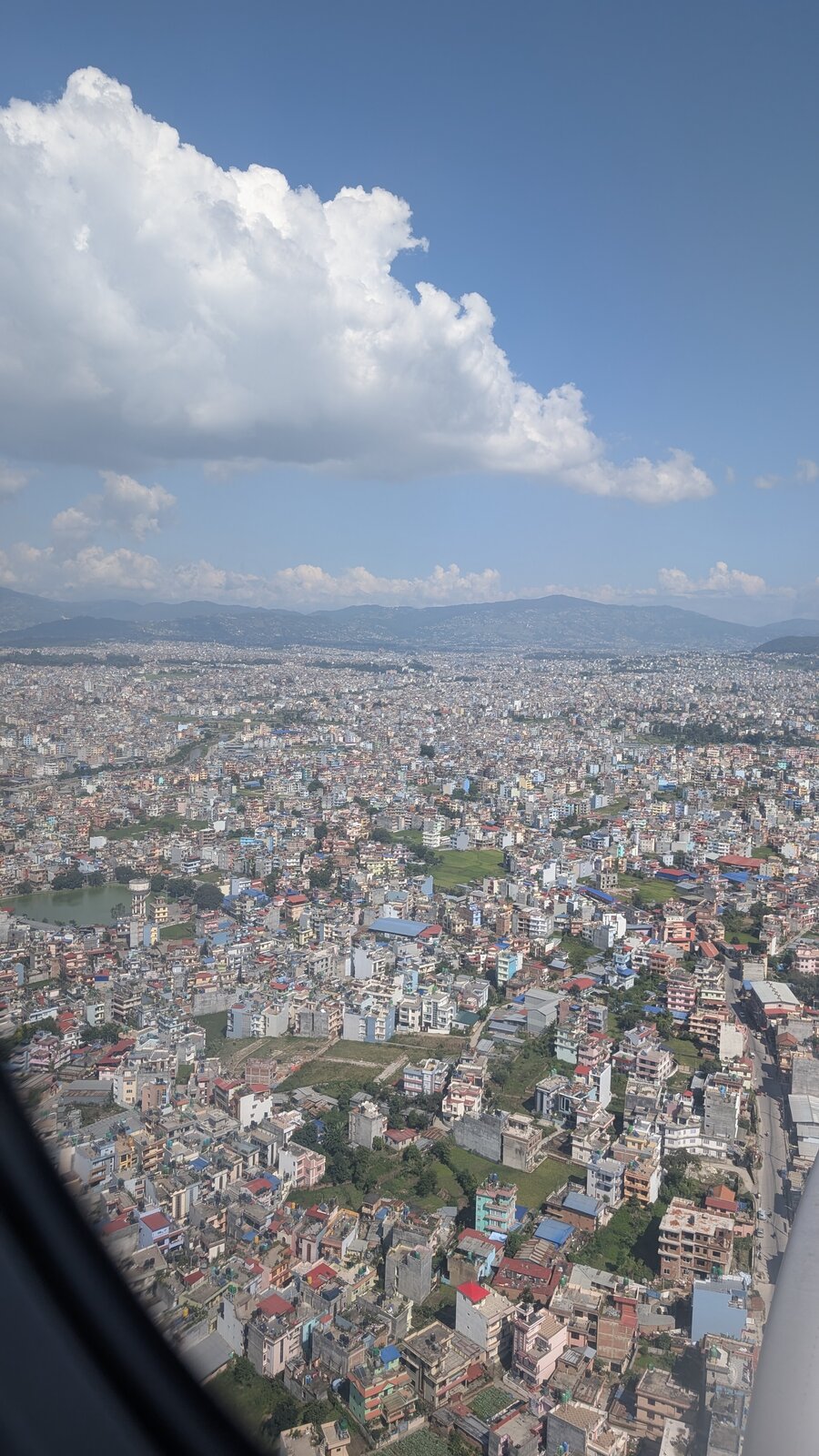
Arriving in Kathmandu.
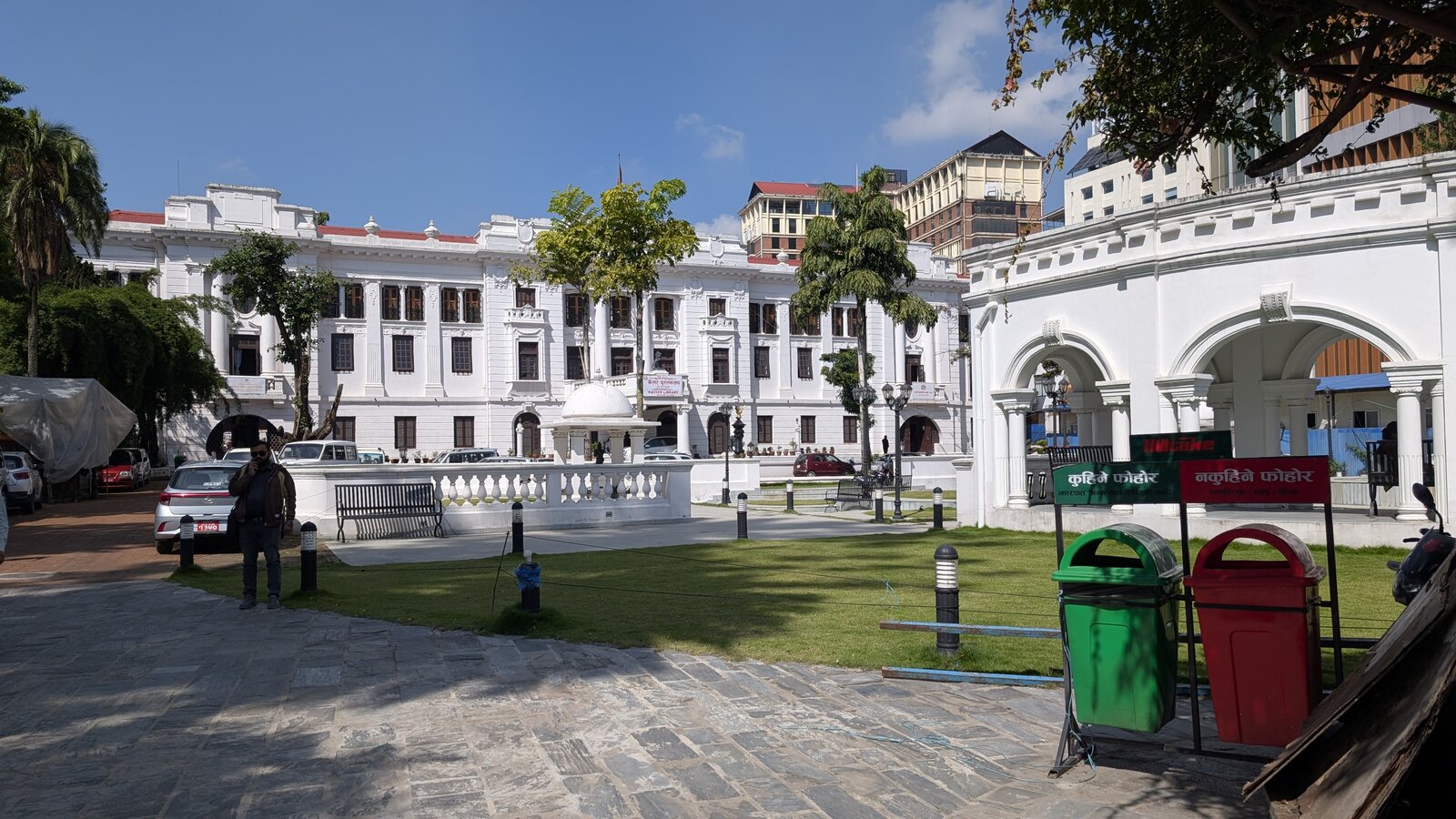
The Kaiser Library
The library was founded in 1907 by the Rana prime minister Chandra Shumsher for his son, Kaiser Shumsher Rana, who built it into one of the great private collections of South Asia. After Kaiser Shumsher’s death the library passed to the Government of Nepal, and it opened to the public in 1969. It is housed in the Kaiser Mahal palace complex on Kantipath, in the centre of Kathmandu. Alongside some 50,000 printed books, it holds an important collection of manuscripts on palm leaf and paper (see Dimitrov and Tamot 2007). KL 699 is the most celebrated of these, and is listed in UNESCO’s Memory of the World Asia-Pacific Register.
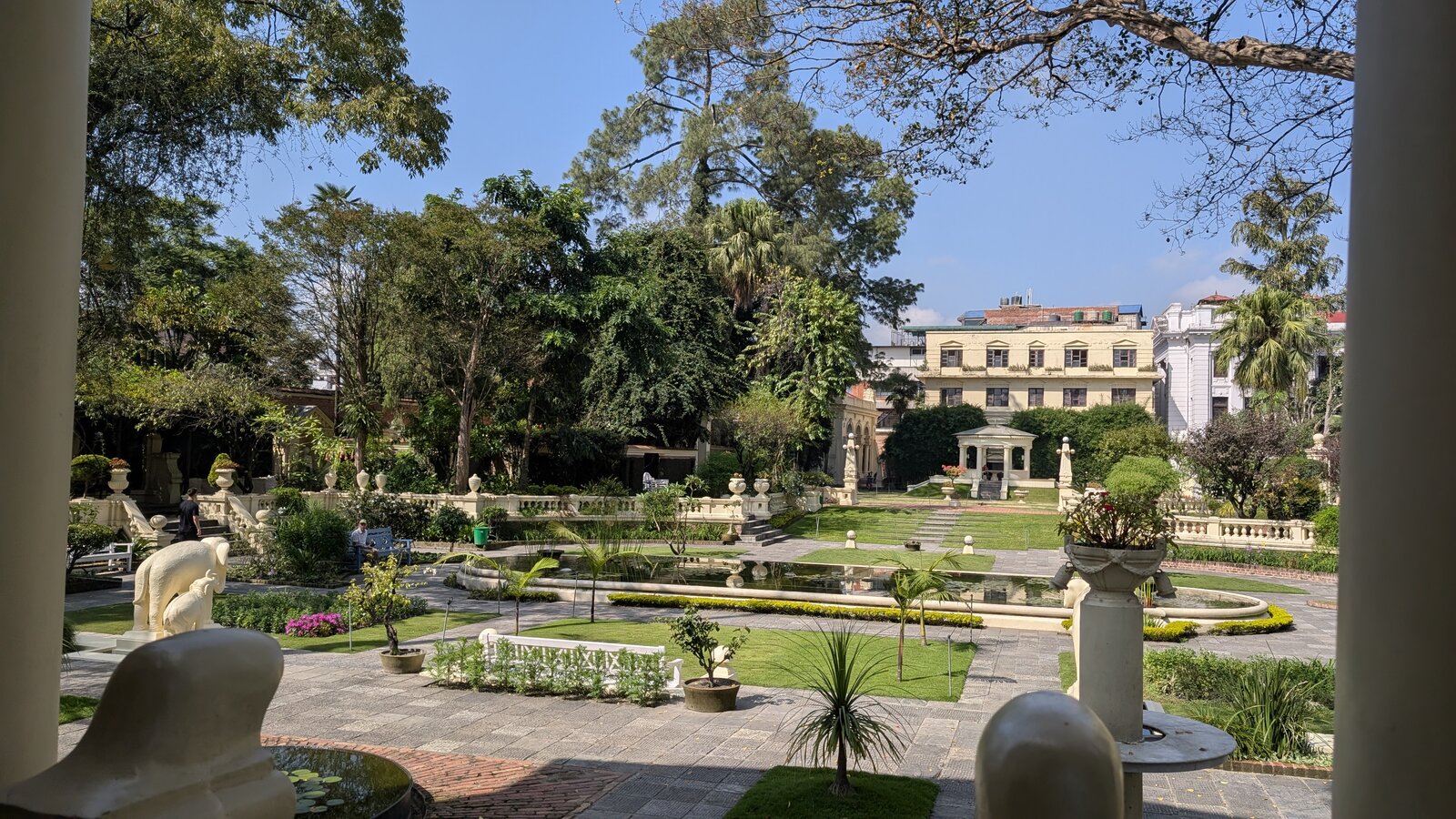
The Garden of Dreams (Svapna Bagaicā), laid out by Kaiser Shumsher beside his palace.
The Kaiser Mahal complex, Kantipath.
Our hosts
We were received by the Chief Librarian, Mr Pradip Bhattarai, and by Ms Binita Giri of the library staff. Both were cordial and welcoming, and generous with their time. We also had the pleasure of meeting Ambika Prasad Regmi, who is preparing a Nepali translation of the Suśrutasaṃhitā based on KL 699. It is very good to know that the manuscript’s text is being made available to readers in Nepal in their own language.
We were accompanied and introduced by Prof. Diwakar Acharya, Spalding Professor of Eastern Religions and Ethics at the University of Oxford. His help in making introductions and in explaining our goals in Nepali was invaluable, and we are most grateful to him.
Seeing KL 699
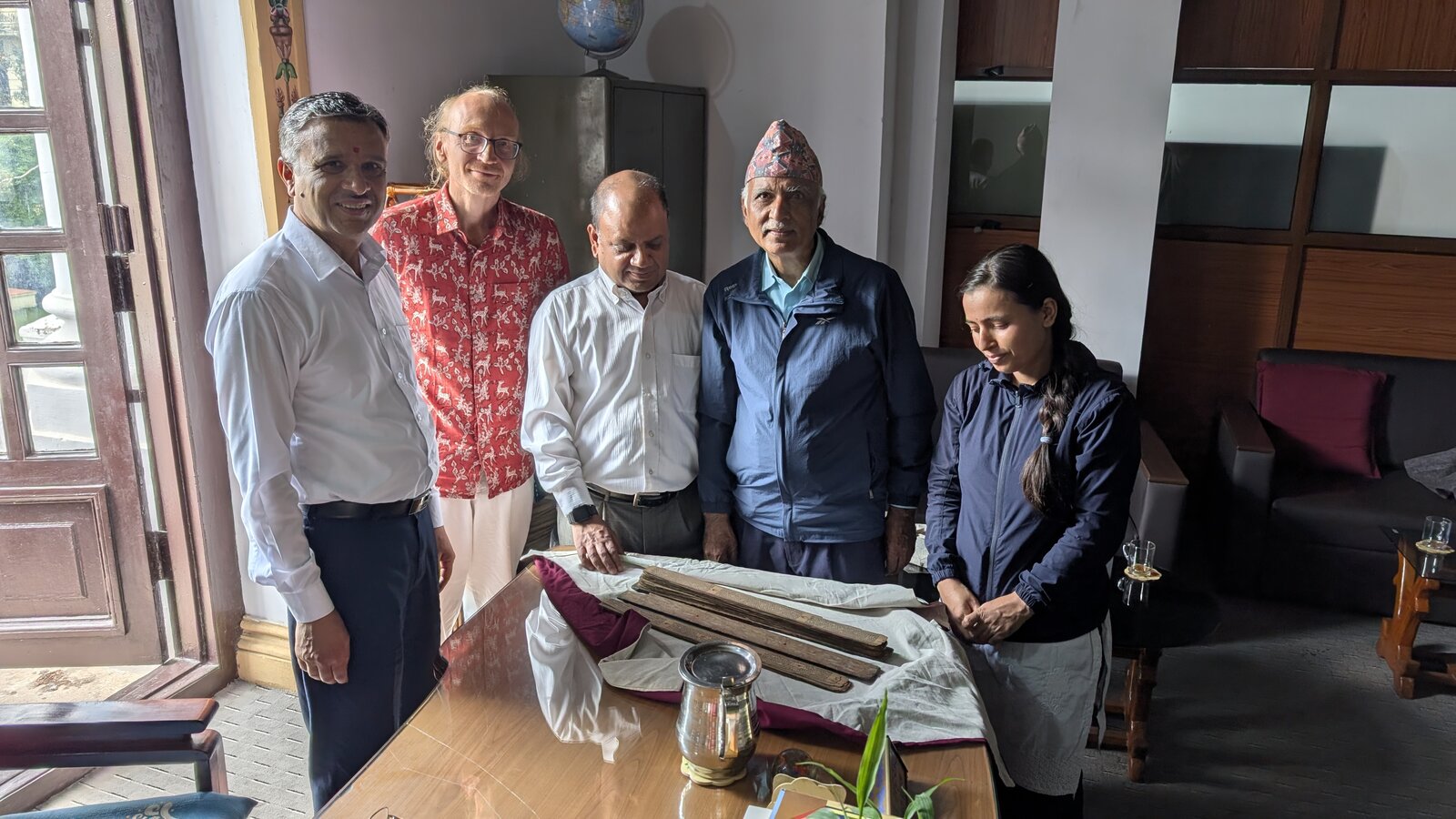
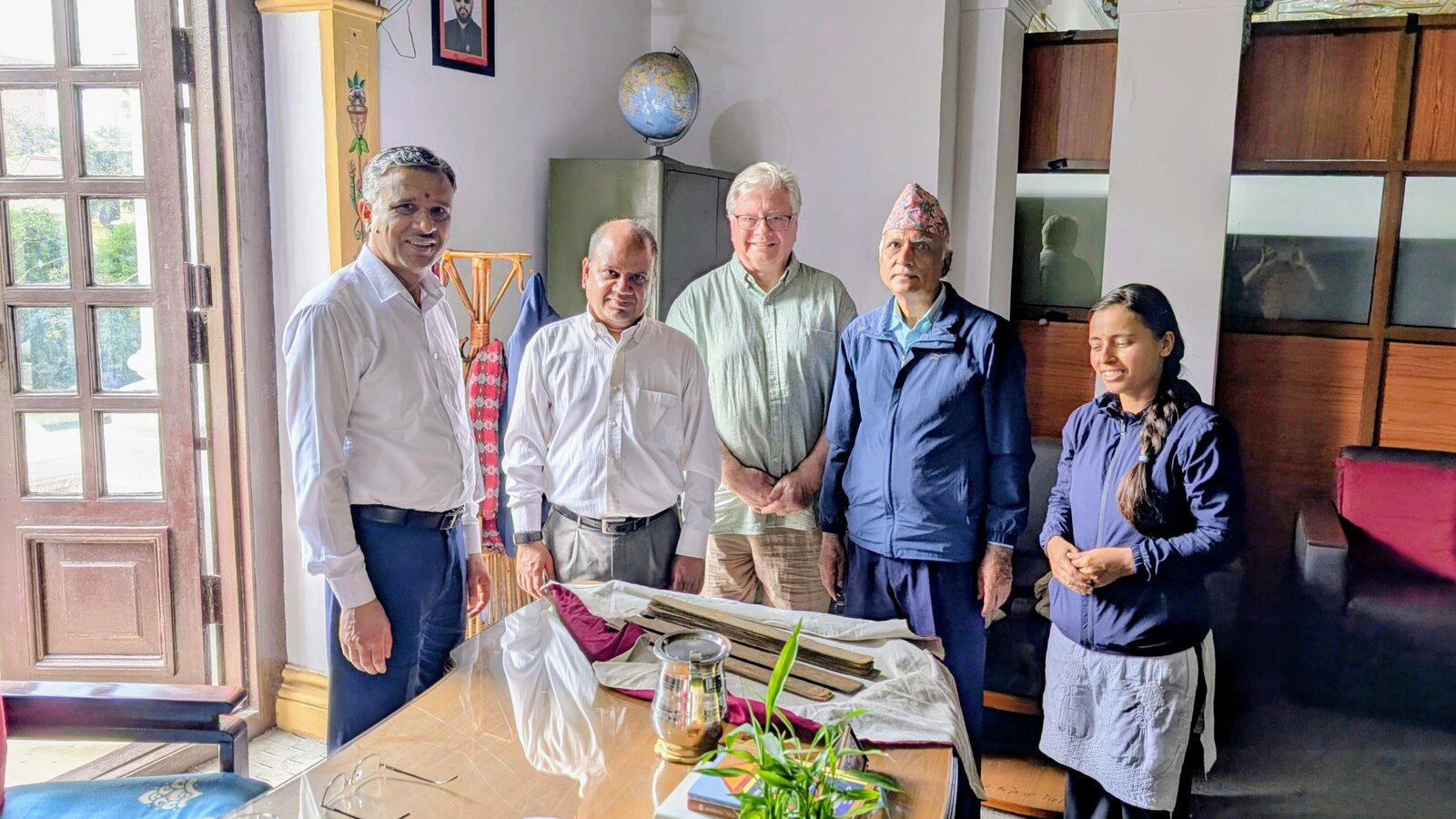
At our request, the manuscript was fetched from the stack and carefully unwrapped and laid out for us on the Chief Librarian’s table. It is a beautiful object. The scribe wrote in small, neat letters, evenly spaced across the long palm leaves, and the text is a pleasure to read.
The leaves are now somewhat dry and fragile, however, and we discussed with Mr Bhattarai the importance of handling the manuscript as little as possible. This is one of the strongest arguments for a good photographic record: once high-quality images are published, scholars will rarely need to consult the original leaves at all.
MS Kathmandu KL 699 unwrapped on the Chief Librarian's table at the Kaiser Library, 30 September 2026.
MS Kathmandu KL 699, folio 219v.
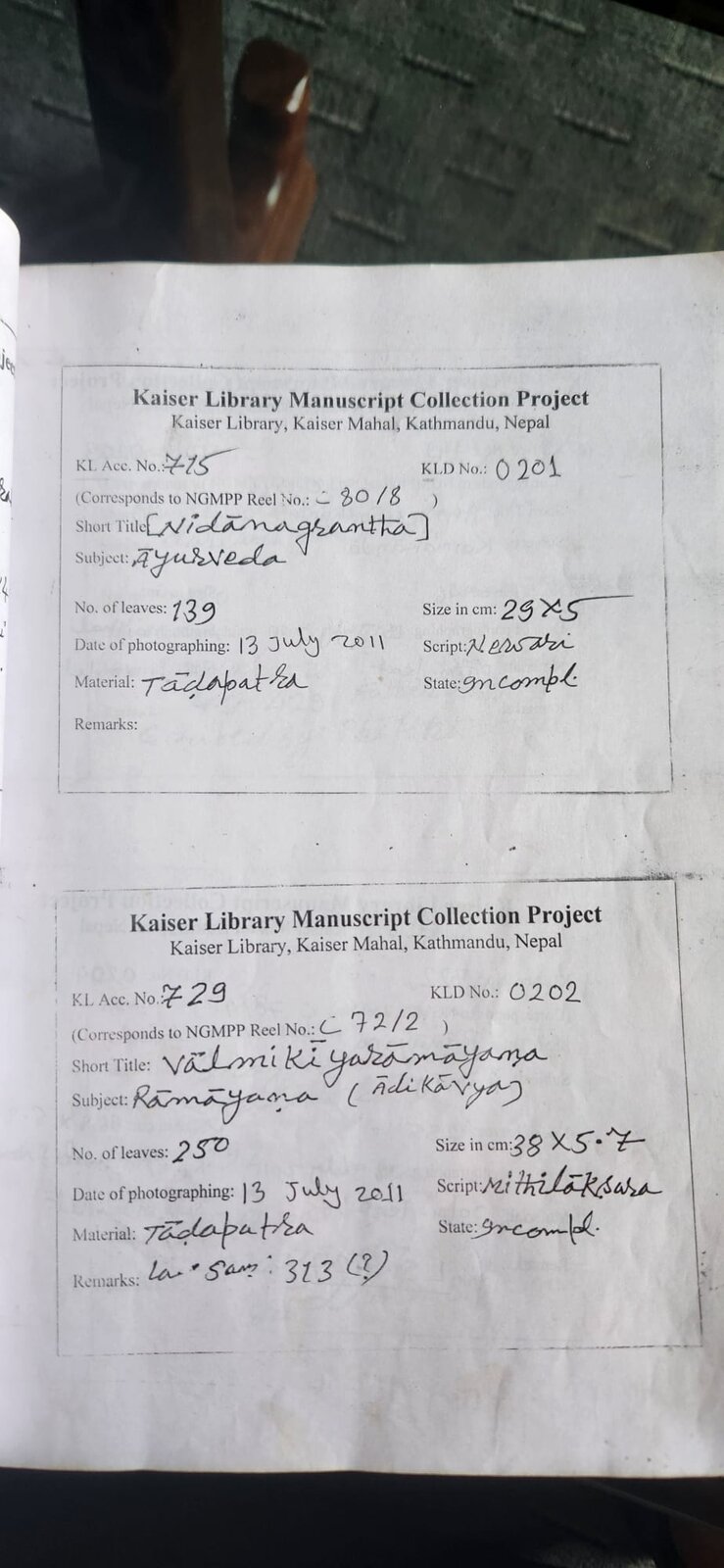
The library also keeps a register of the manuscripts photographed under its Kaiser Library Manuscript Collection Project, recording for each item its accession number, the corresponding NGMPP microfilm reel, title, subject, extent, size, script and condition.
A page from the register of the Kaiser Library Manuscript Collection Project. The upper entry, KL 715, is an Āyurvedic work recorded as Nidānagrantha.
A proposed facsimile edition
We proposed to the Chief Librarian that the Kaiser Library and the Suśruta Project collaborate on a facsimile edition of MS Kathmandu KL 699. The facsimile would be accompanied by a diplomatic transcription of the text, building on the transcription prepared during the first phase of the project. Such an edition would make this unique witness to the early history of Indian medicine available to scholars everywhere, while protecting the original from further handling.
Mr Bhattarai responded positively to the proposal. He will pass the plan to the library’s legal office and to the Ministry of Education for approval. We look forward to hearing from him and, we hope, to beginning work together.
We thank Mr Pradip Bhattarai, Ms Binita Giri and Ambika Prasad Regmi for their warm welcome, and Prof. Diwakar Acharya for making the meeting possible.
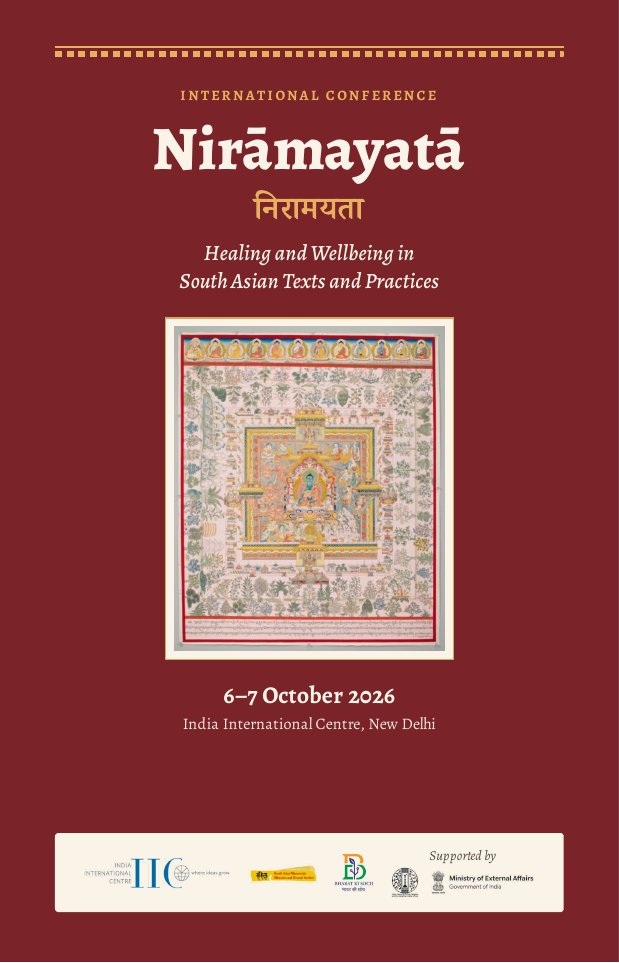
]]>Dominik WujastykNirāmayatā: Healing and Wellbeing at the India International Centre, New Delhi2026-10-09T08:30:00+00:002026-10-09T08:30:00+00:00https://sushrutaproject2.github.io/blog/2026/Niramayata-conference-at-IICOn 6–7 October 2026, three members of the Suśruta Project, Dominik Wujastyk, Jason Birch and Kenneth Zysk, took part in the international conference Nirāmayatā (निरामयता): Healing and Wellbeing in South Asian Texts and Practices, held at the India International Centre (IIC) in New Delhi. We were the guests of the IIC–International Research Division (IRD) and its Executive Director, Dr Sudha Gopalakrishnan, who conceived the conference and invited us to speak.
The conference programme. The cover shows a modern copy of the Medicine Buddha Palace, the first of the Tibetan Medical Paintings from the Mentsikhang, Lhasa (Rubin Museum of Himalayan Art).
The IRD and the SAMHiTA programme
The International Research Division grew out of the IIC-Asia Project, which from 1997 onward held annual conferences on the cultures of Asia, for many years under the guidance of Dr Kapila Vatsyayan. Since 2022 the Division has run SAMHiTA (South Asian Manuscript Histories and Textual Archive), a programme supported by the Ministry of External Affairs to inventory, catalogue and digitise South Asian manuscripts held in libraries and archives outside India. Its knowledge partners include the PANDiT project, the Old Indian Institute at Oxford, SOAS, the Wellcome Collection, the Royal Danish Library and the Bibliothèque nationale de France.
The Nirāmayatā conference was organised by the IRD in collaboration with the Indian Council for Cultural Relations and the Bharat ki Soch Foundation, within the framework of SAMHiTA. Its aim was to look at Indian and wider Asian medical traditions through manuscripts and living practice: how medical knowledge was produced, circulated and transformed, and how it moved between Sanskrit, Tamil, Persianate, Tibetan and Southeast Asian traditions. Over two days, six sessions brought together historians, philologists, practitioners of Ayurveda, Siddha, Unani and Sowa Rigpa, and biomedical scientists.
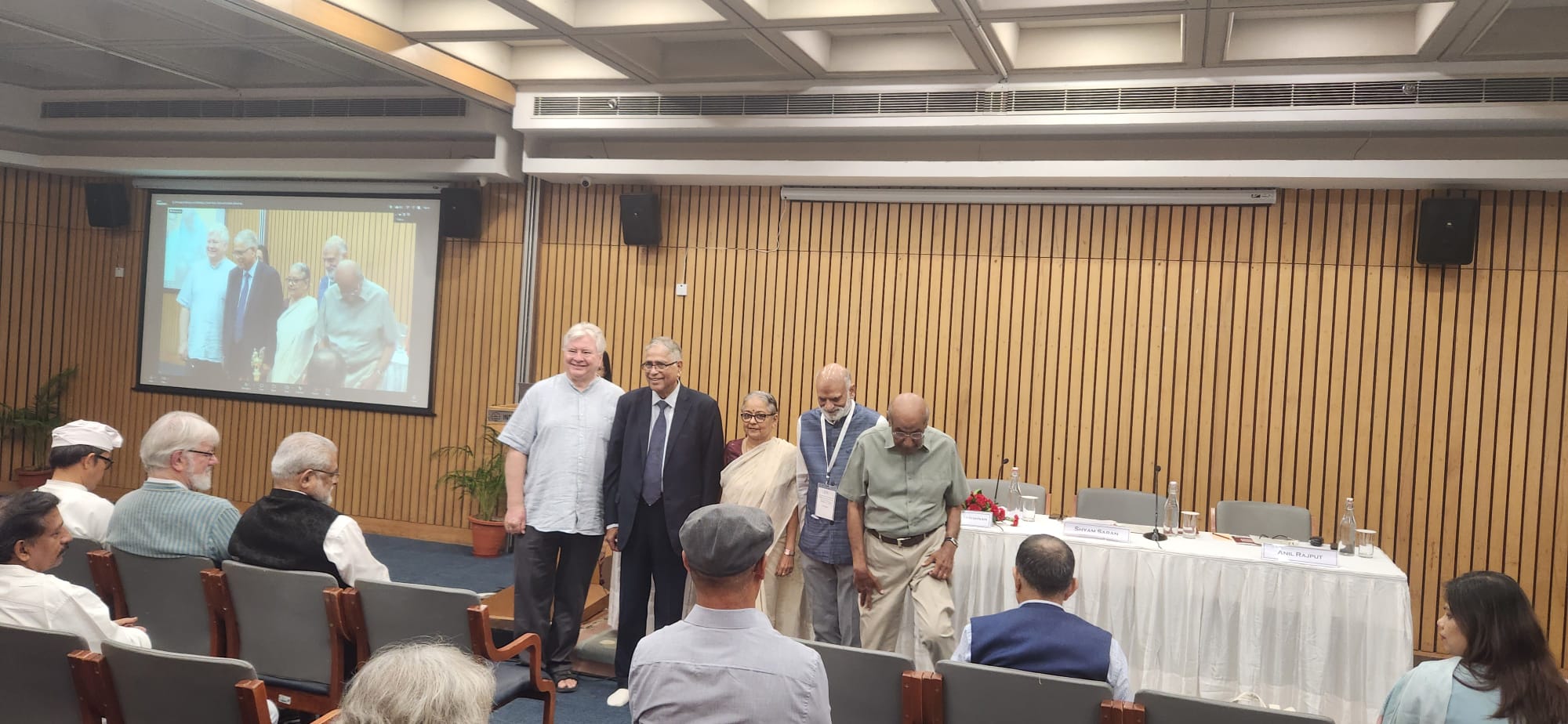
The inaugural session, after the lighting of the lamp: L-R: Dominik Wujastyk, K. N. Shrivastava, Sudha Gopalakrishnan, Anil Rajput, Shyam Saran.
Our presentations
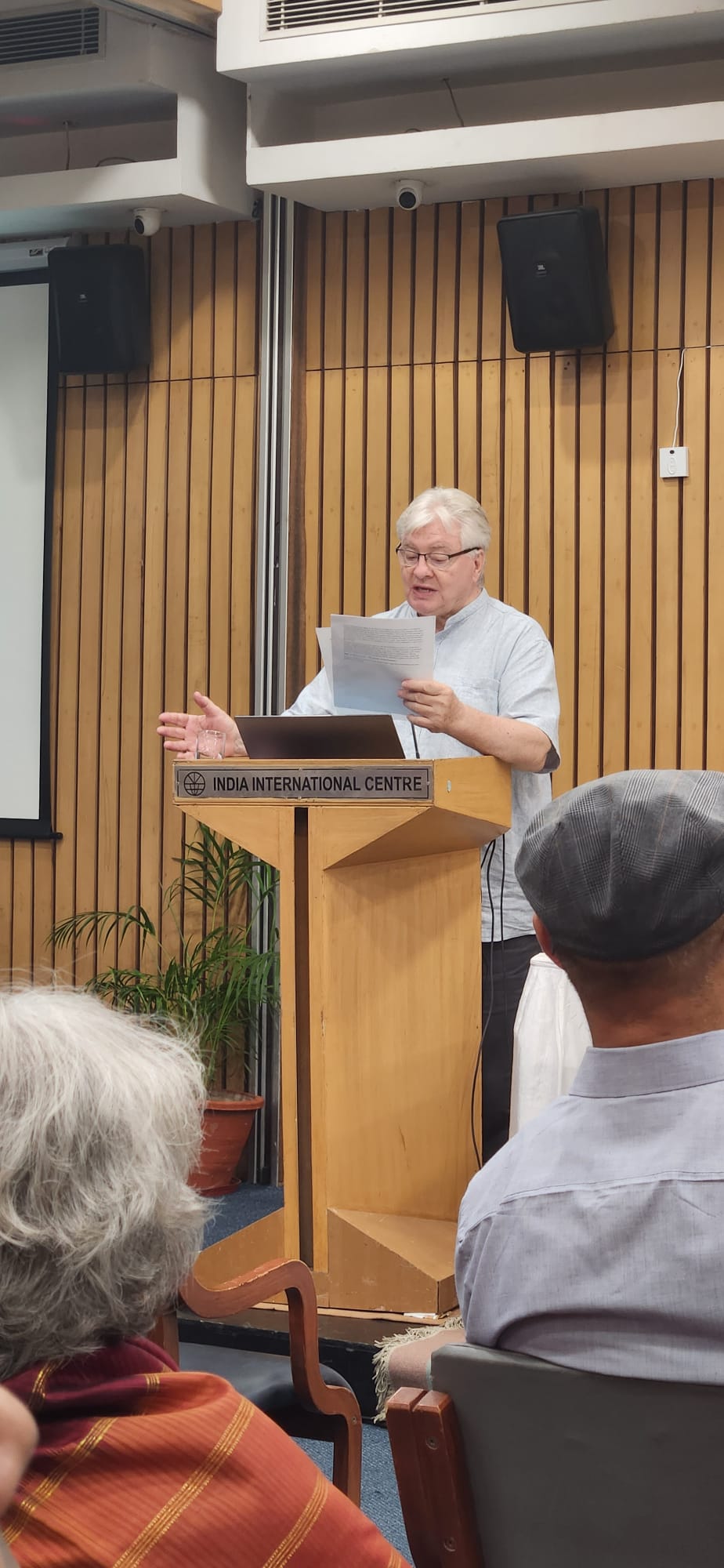
Keynote address. After the inaugural addresses by Shri K. N. Shrivastava (Director, IIC), Dr Sudha Gopalakrishnan, Shri Anil Rajput (Bharat ki Soch) and Shri Shyam Saran (President, IIC), Dominik Wujastyk gave the keynote address, “Achieving Healthiness and the Absence of Illness in Ayurveda.” The title takes up the theme of the conference itself, since nirāmayatā means “freedom from disease.”
Dominik Wujastyk delivering the keynote address.
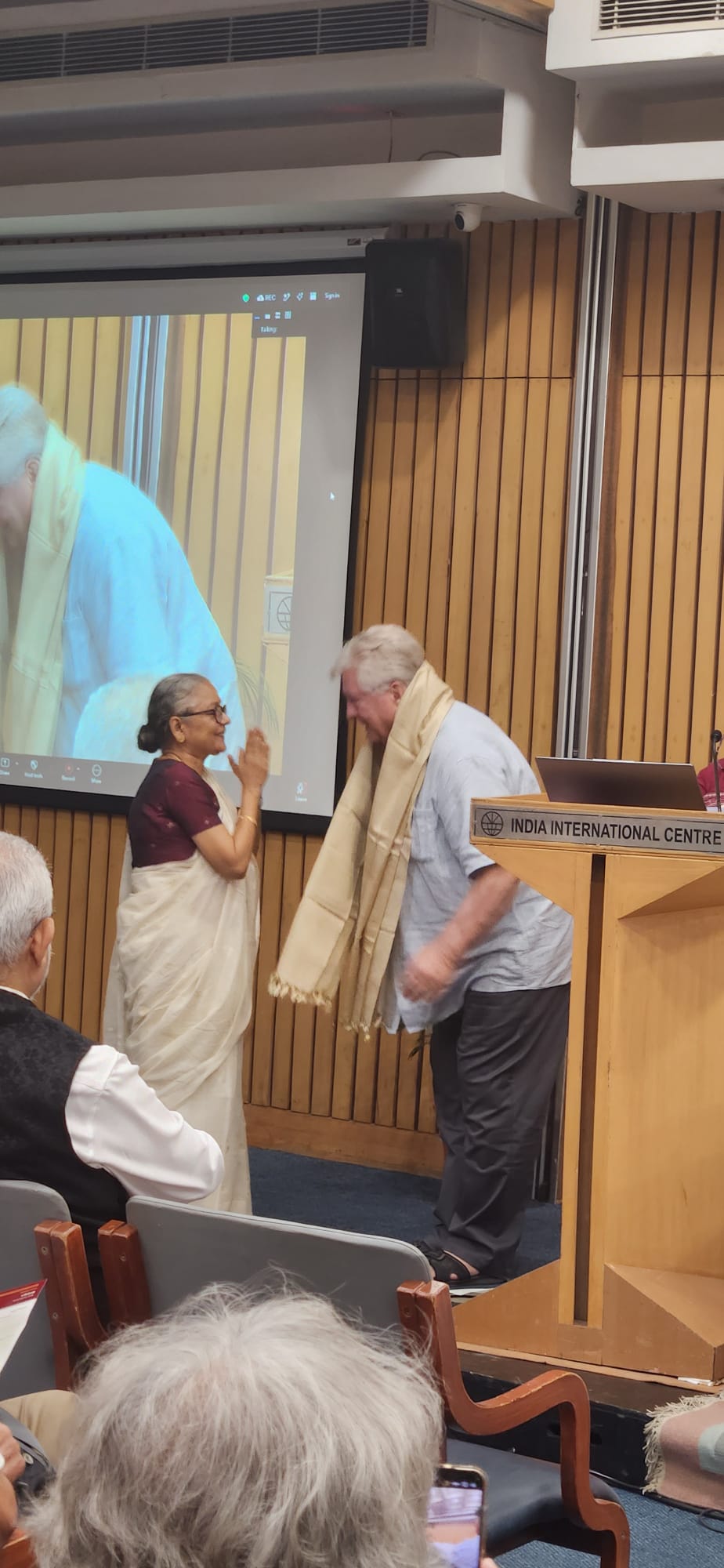
Dr Sudha Gopalakrishnan honouring the keynote speaker with a shawl.
Dissection in the Suśrutasaṃhitā. In the first session, “Texts and Concepts on Medical Thought,” chaired by Prof. G. G. Gangadharan, Kenneth Zysk spoke on “What Medical Literature Can Reveal: Dissection in the Suśruta Saṃhitā, Internal and External Transmission.” The Suśrutasaṃhitā’s instructions for preparing and examining a human body in the Śārīrasthāna are unique in early Indian literature, and raise questions both about how this knowledge was passed on within the medical tradition and about its relations with knowledge from outside it.
Suśruta on preserving health. In the afternoon session, “Mind and Body in Asian Medical Traditions,” chaired by Dr S. Irfan Habib, Jason Birch spoke on “From Svastharakṣaṇīya to Svasthavṛtti: How Suśruta’s Chapter on Preserving a Person’s Health Changed.” The paper traced how the Suśrutasaṃhitā’s teaching on keeping a healthy person healthy was reshaped over the course of the work’s transmission.
Other contributions
Our papers sat alongside a wide range of others (program). Among them were Dr S. A. S. Sarma on Gāruḍa Tantra traditions of snakebite medicine in Kerala; Dr Mehsaan Barawaz on the Persian Majmūʿah-i Żiyāʾī and the meeting of Unani and Ayurvedic learning; Dr Padma Gurmet on Sowa Rigpa; Sugi Lanus on herbal and ritual healing in Balinese lontar manuscripts; Dr Annamma Spudich on European documents about South Indian medicine in the sixteenth to eighteenth centuries; and Prof. Nupur Dasgupta on regional environmental knowledge in Cakrapāṇidatta’s Dravyaguṇasaṃgraha and Mādhavakara’s Paryāyaratnamālā. A session on traditional and modern medicine, with Prof. Bhushan Patwardhan and Prof. Rama Jayasundar, and a closing round table on future directions for traditional knowledge, chaired by Vaidya Rajesh Kotecha, brought the perspectives of science and public policy into the discussion.
Thanks
We are very grateful to Dr Sudha Gopalakrishnan and the staff of the International Research Division for their invitation, their careful organisation and their generous hospitality. The day after the conference, on 8 October, we also visited the Ministry of Culture and Gyan Bharatam, the national manuscript mission; that visit is described in a separate post.
]]>Dominik WujastykA Visit to Gyan Bharatam and the Ministry of Culture, New Delhi2026-10-09T03:30:00+00:002026-10-09T03:30:00+00:00https://sushrutaproject2.github.io/blog/2026/meeting-at-Gyan-BharatamOn 8 October 2026, three members of the Suśruta Project, Dominik Wujastyk, Jason Birch and Kenneth Zysk, spent an afternoon in New Delhi as guests of Gyan Bharatam, the Government of India’s national mission for the survey, conservation and digitisation of manuscripts.
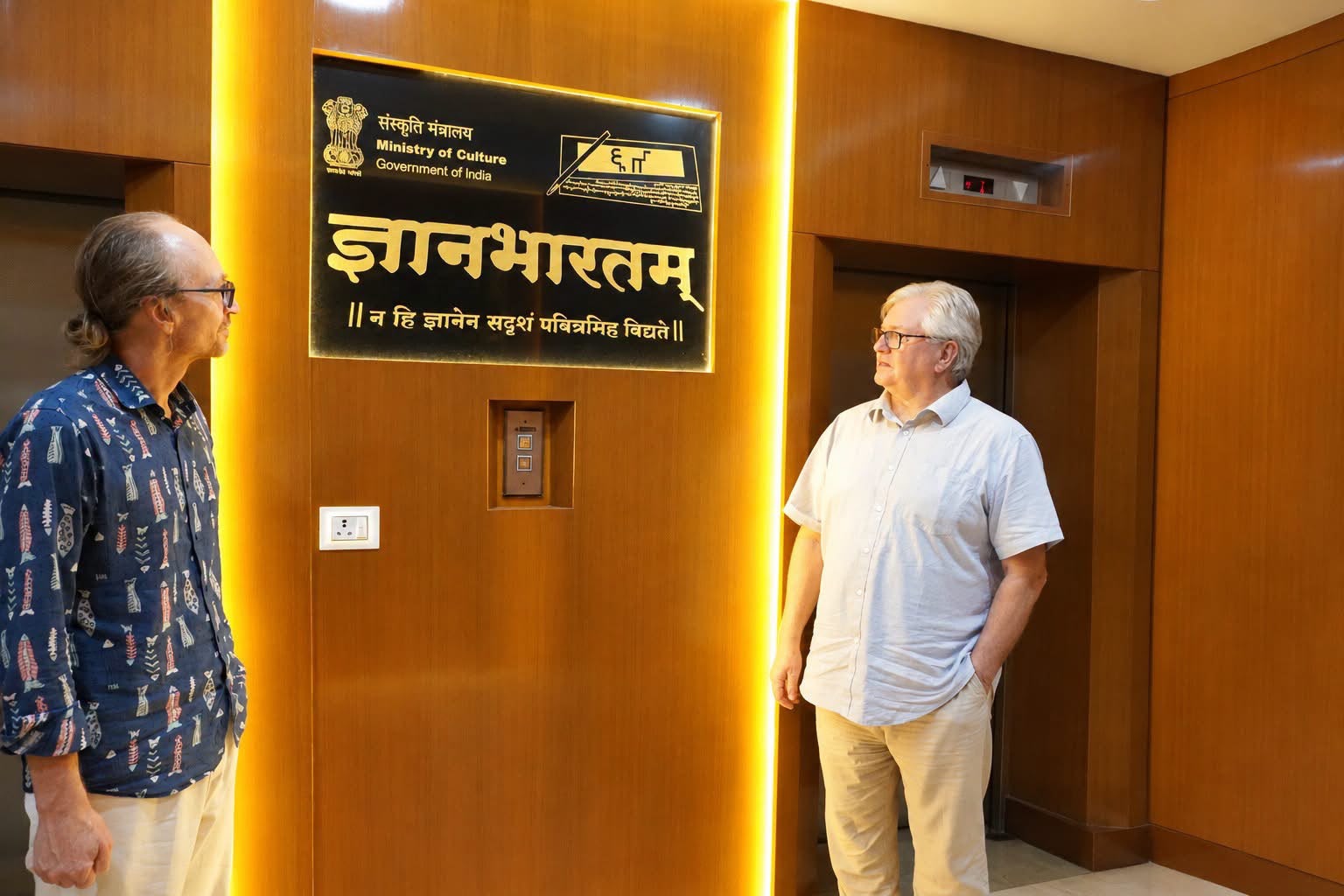
Gyan Bharatam (Jñānabhāratam) was announced in the Union Budget for 2025–26 as a flagship programme of the Ministry of Culture. It builds on the work of the National Mission for Manuscripts, founded in 2003, and aims to document, conserve and make available more than ten million manuscripts held in libraries, institutions and private collections across India. The mission’s emblem carries the motto na hi jñānena sadṛśaṃ pavitram iha vidyate, “for nothing in this world purifies like knowledge” (Bhagavadgītā 4.38ab).
Jason Birch (left) and Dominik Wujastyk at the entrance to the Gyan Bharatam offices, beneath the mission's emblem and motto.
Meeting with the Secretary of the Ministry of Culture
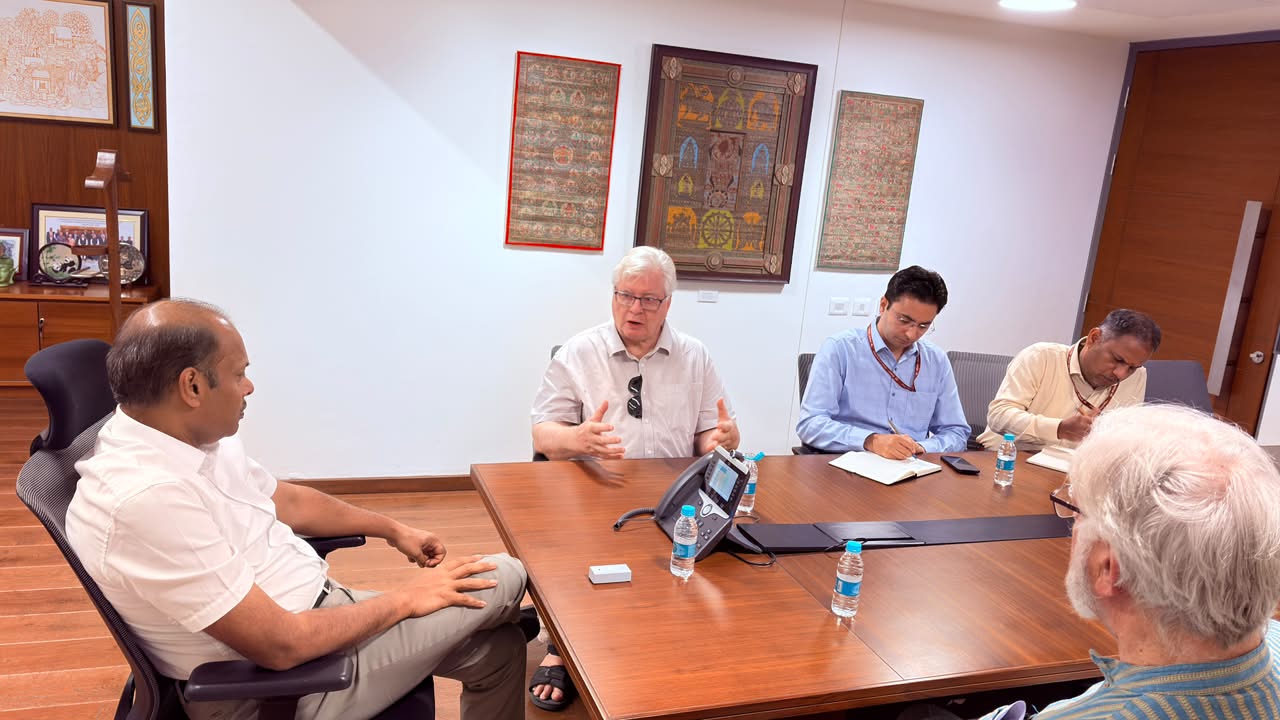
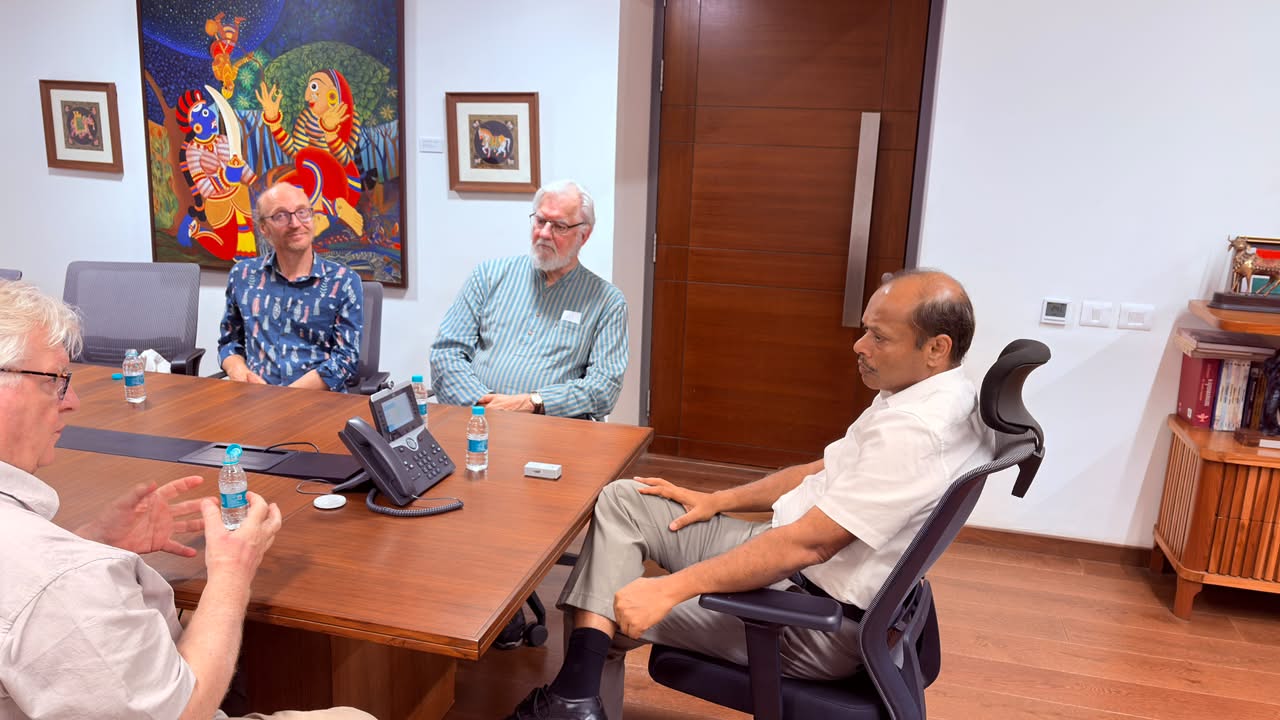
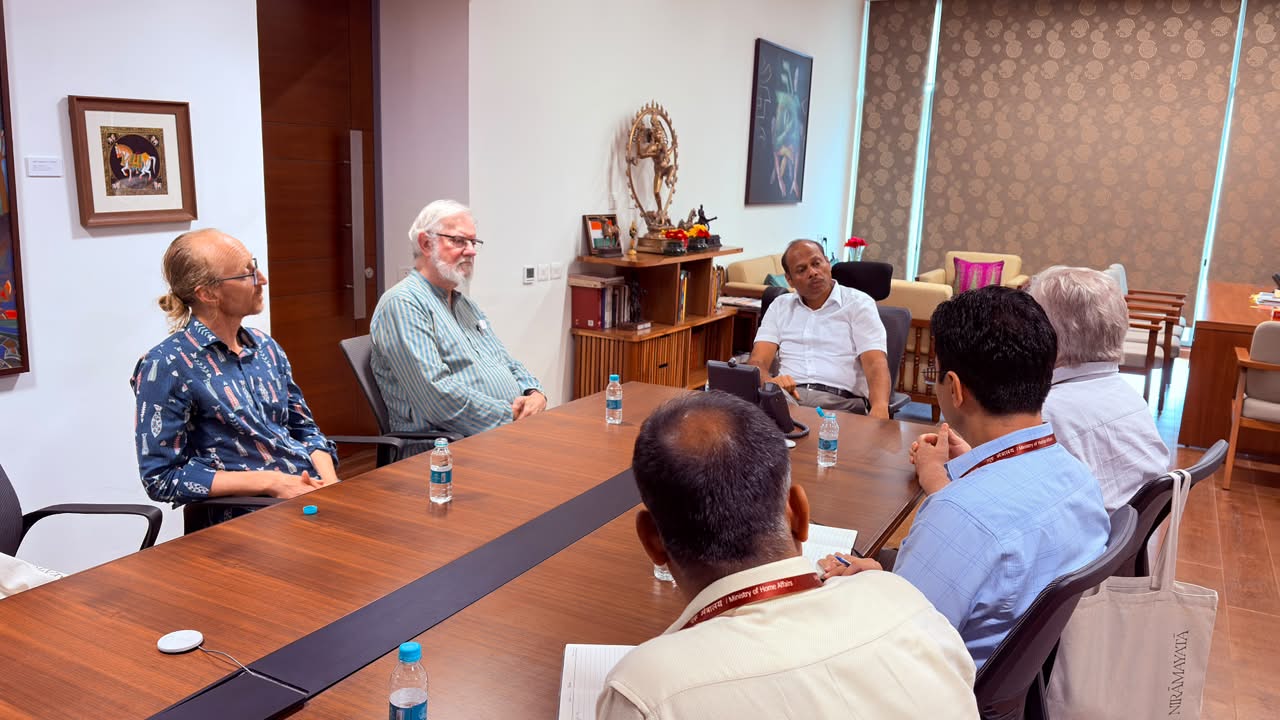
Gyan Bharatam’s director, Dr Anirban Dash, first took us to the Ministry of Culture at Kartavya Bhavan. There we had an hour-long meeting with Shri Vivek Agarwal, Secretary of the Ministry of Culture, who has overall charge of the Gyan Bharatam mission.
The Secretary outlined the ambitious goals of the Government of India’s drive to digitise manuscripts across the country. He then listened carefully to our ideas and suggestions, drawn from our experience of working with Sanskrit medical manuscripts in Indian and international collections. He generously offered the support of Gyan Bharatam for projects that we might propose for action. We are very grateful for his time and his openness to collaboration.
Dominik Wujastyk speaking at the meeting with the Secretary.
Jason Birch and Kenneth Zysk (centre) with Shri Vivek Agarwal (right).
The meeting at the Ministry of Culture, Kartavya Bhavan.
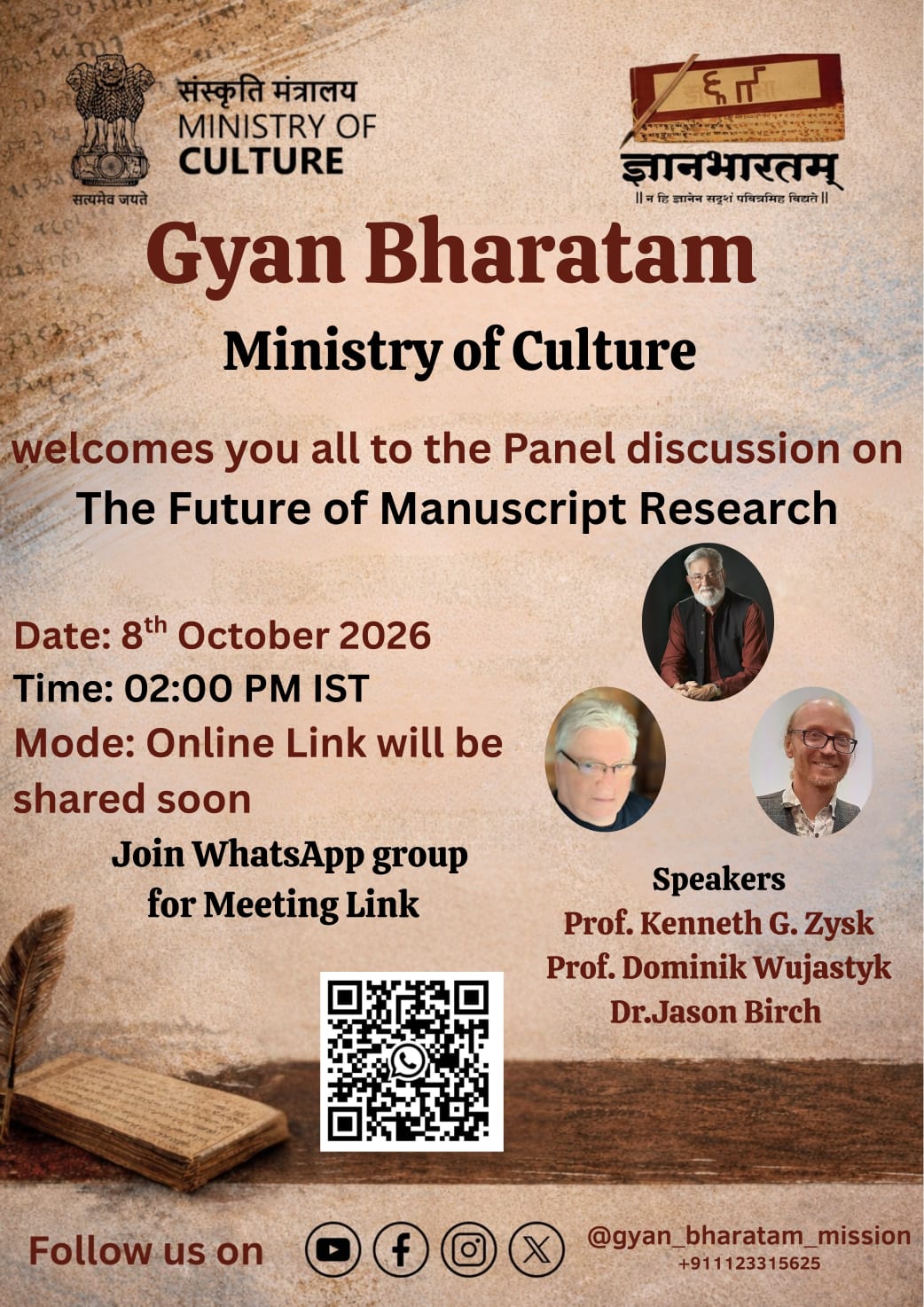
Round table at Gyan Bharatam: “The Future of Manuscript Research”
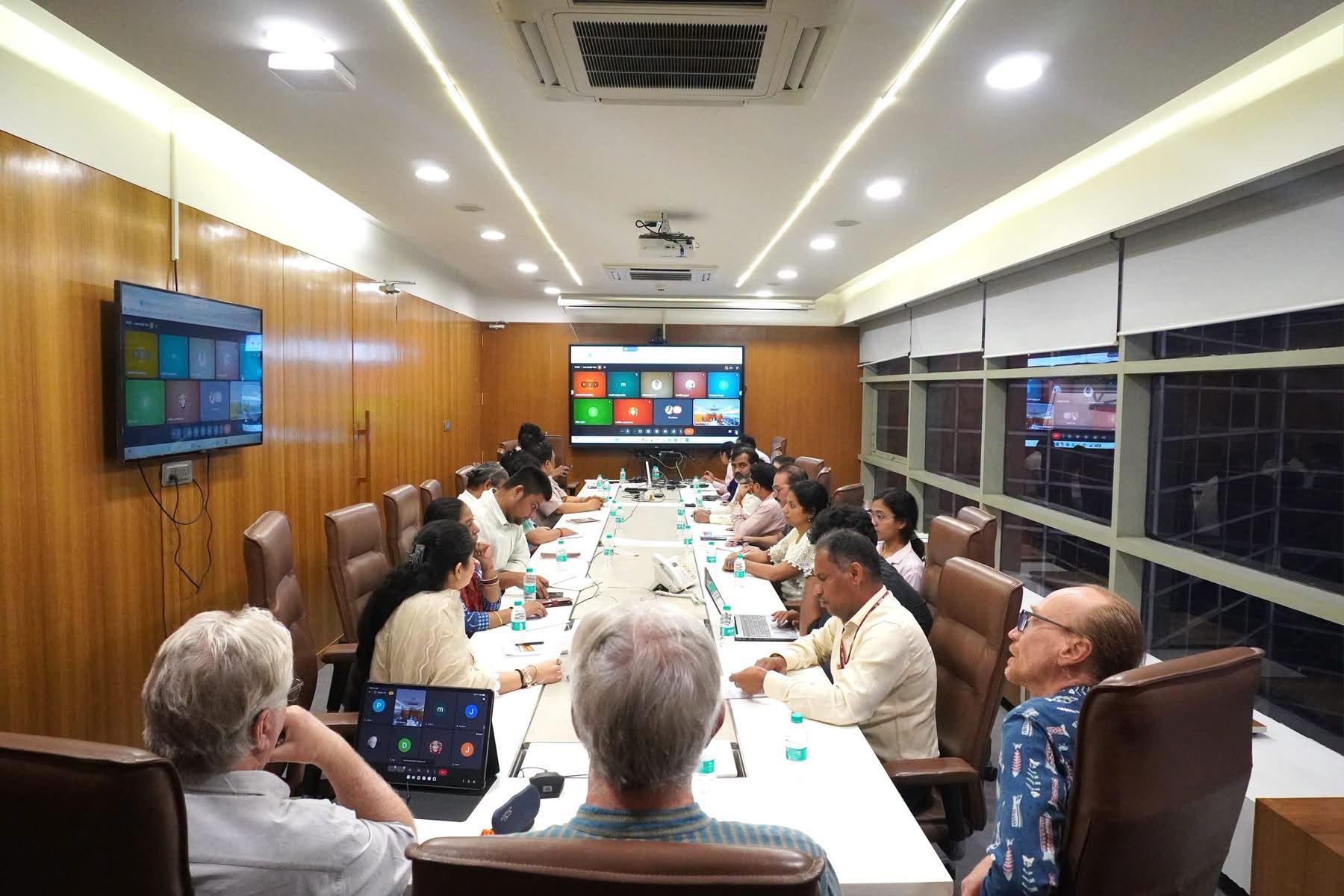
After the meeting with the Secretary, we moved to the offices of Gyan Bharatam for an hour-long consultative round table on “The Future of Manuscript Research.” The session was chaired by Dr Anirban Dash, with members of the Gyan Bharatam team, and was live-streamed online.
The discussion ranged over the goals and meaning of Gyan Bharatam’s work and the importance and value of manuscript studies. Manuscripts are the primary evidence for almost everything we know about India’s intellectual history, including its medicine. The texts we read in printed editions are reconstructions from these witnesses, and their quality depends on the range and accuracy of the manuscripts consulted. A national effort to locate, catalogue and digitise manuscripts therefore directly benefits work such as ours on the Suśrutasaṃhitā and its commentaries. The session closed with questions from participants both in the room and online.
The round table at Gyan Bharatam, with online participants on the screens.
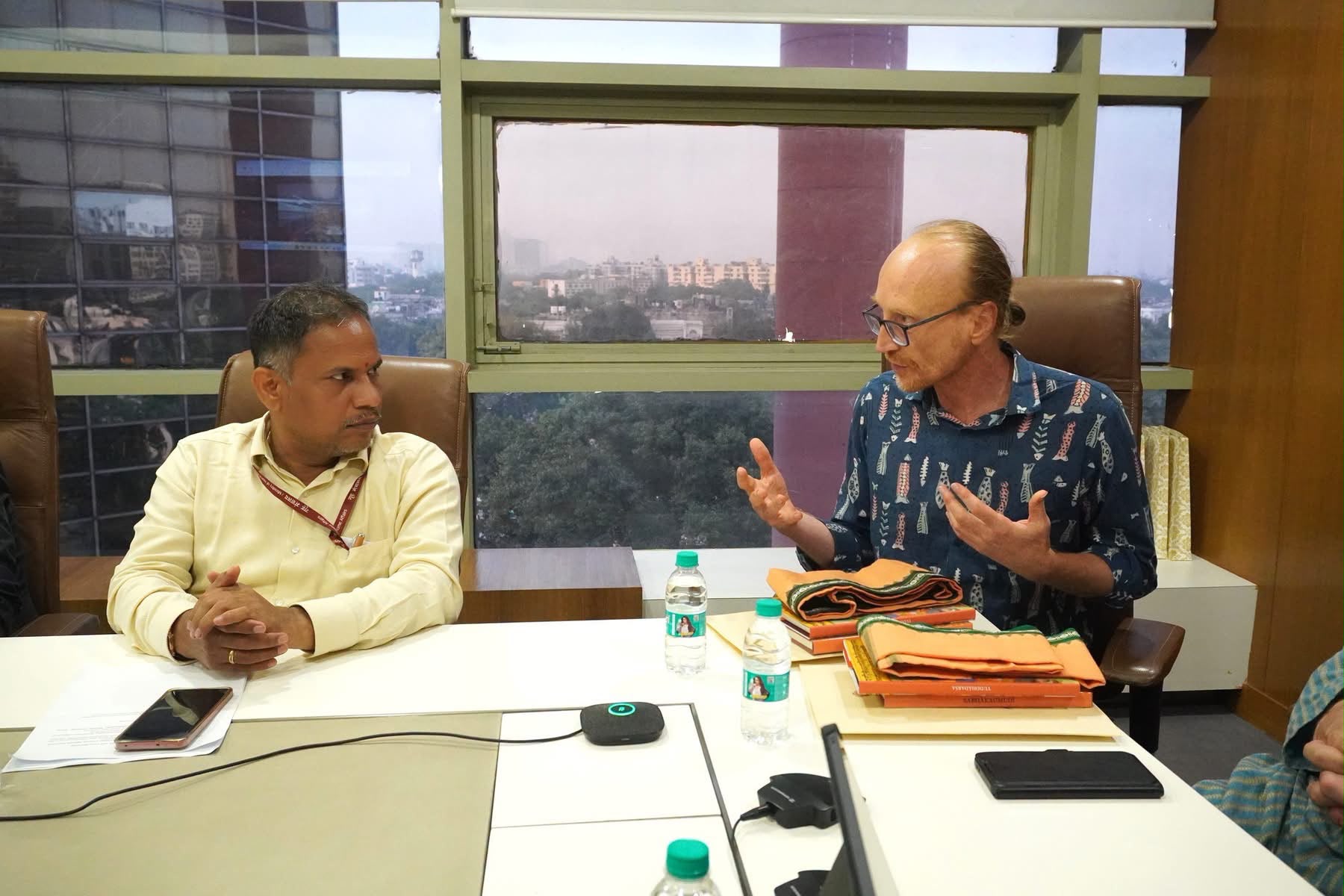
Jason Birch speaking at the round table; Dr Anirban Dash on the left.
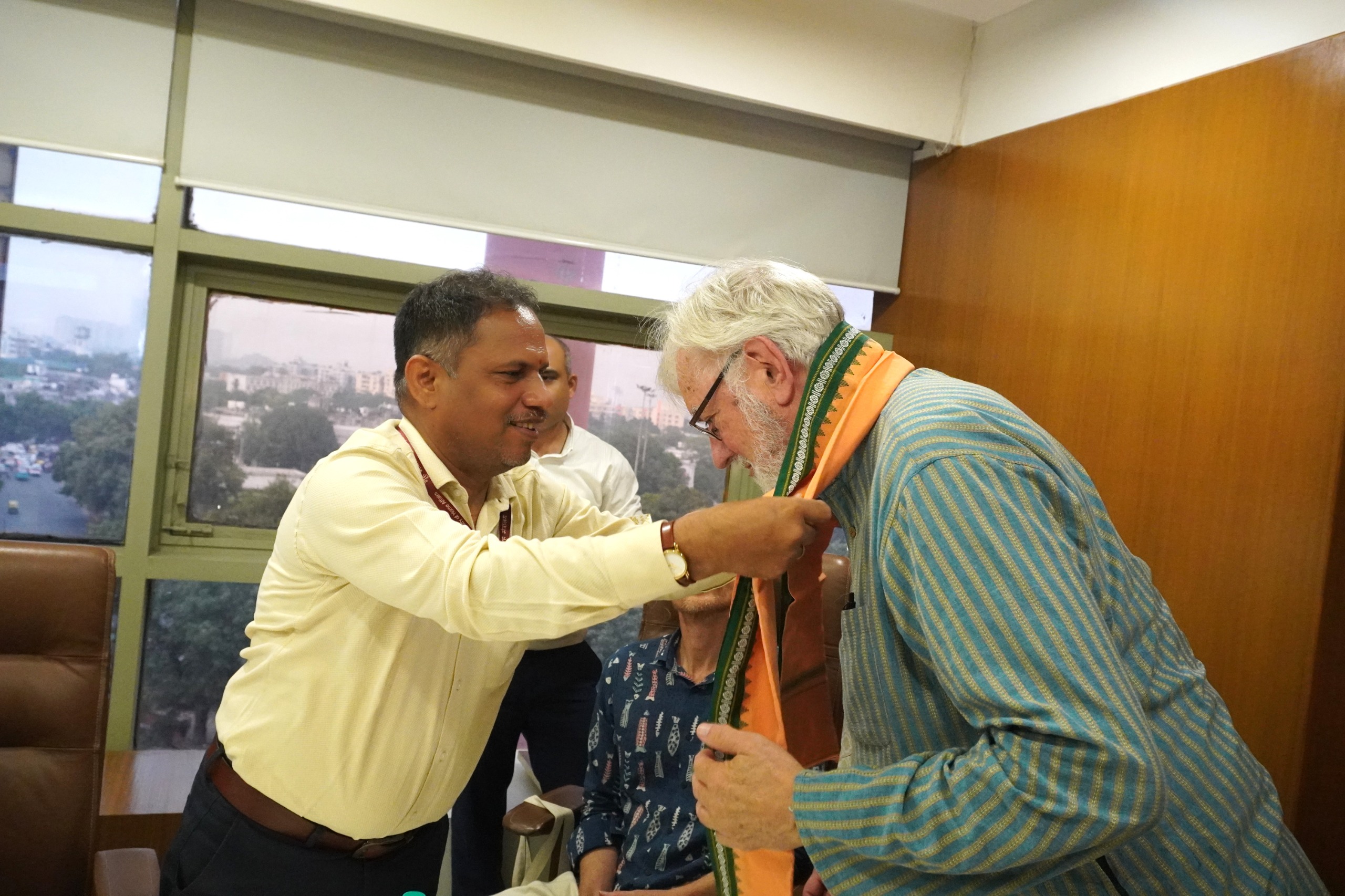
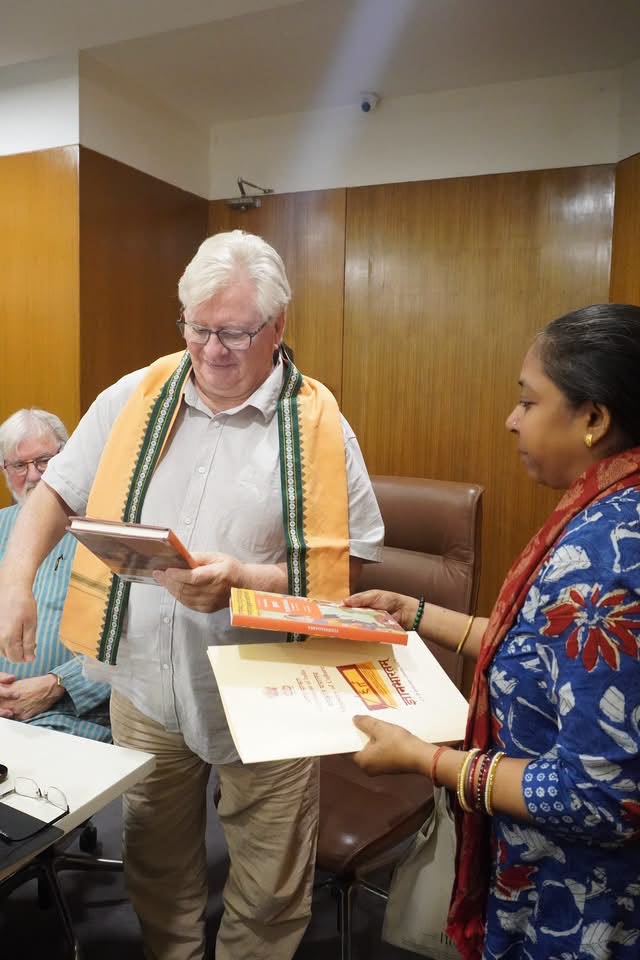
At Gyan Bharatam we were welcomed in the traditional manner with shawls and gifts of books.
Dr Anirban Dash presenting a shawl to Kenneth Zysk.
Dominik Wujastyk receiving a shawl and books, with Kenneth Zysk looking on.
Gyan Bharatam's announcement of the round table.
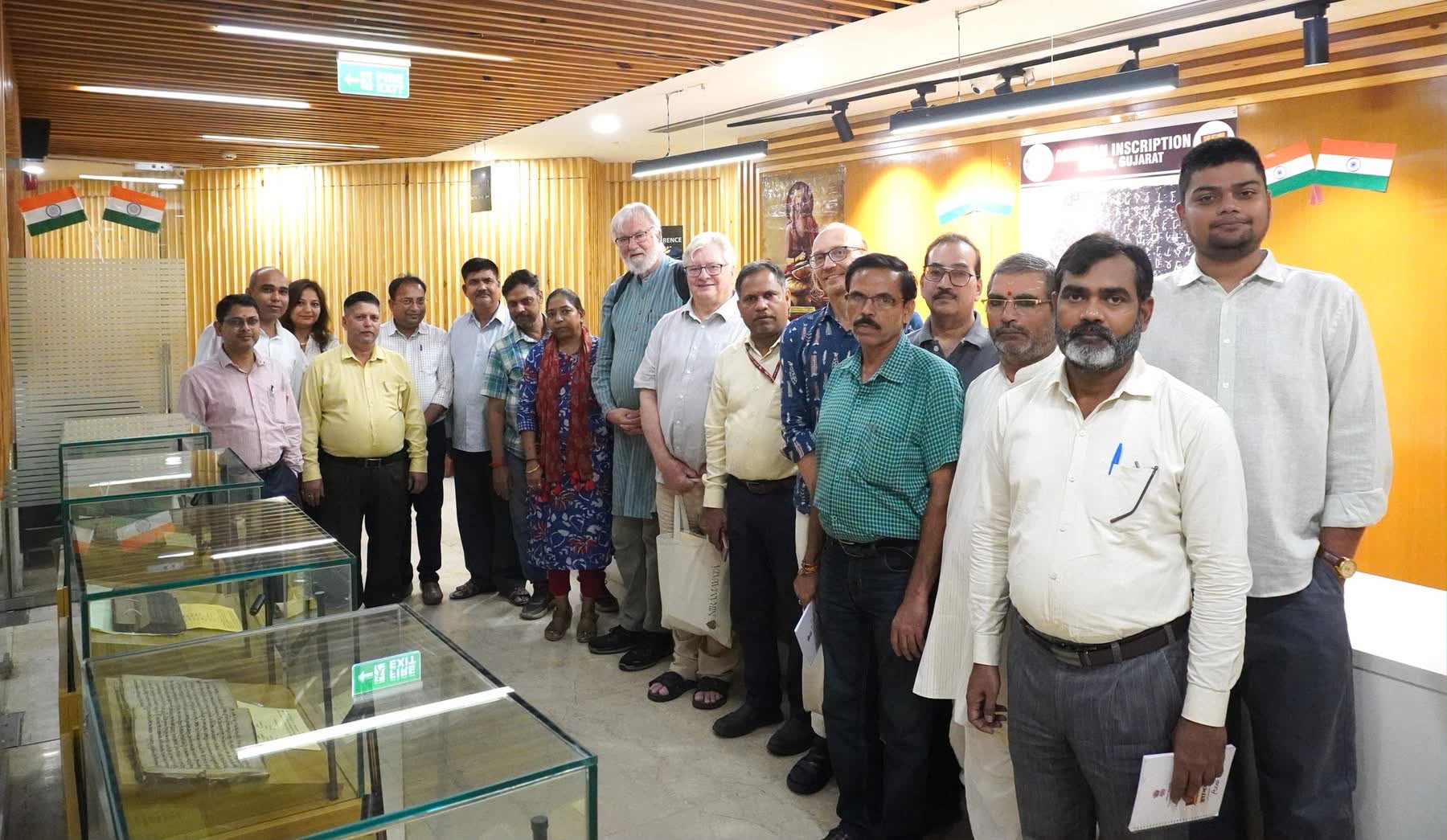
Kenneth Zysk, Dominik Wujastyk, Anirban Dash and Jason Birch (centre) with members of the Gyan Bharatam team, beside a display of manuscripts.
We thank Dr Anirban Dash and the Gyan Bharatam team for their warm hospitality and for organising both meetings, and Shri Vivek Agarwal for his interest and encouragement. We look forward to developing proposals for collaboration in the coming months.
]]>Dominik WujastykA New Manuscript of Gayadāsa’s Nyāyacandrikā2026-08-28T12:00:00+00:002026-08-28T12:00:00+00:00https://sushrutaproject2.github.io/blog/2026/a-new-manuscript-of-Gayadasas-NyayacandrikaDr Harshal Bhatt, a long-term research associate of the Suśruta Project, recently conducted a research trip to Jaipur, where he obtained a digital copy of manuscript RORI 6838. Our team has only begun to examine this source, but it already appears exciting for two reasons. First, it preserves a substantial copy of Gayadāsa’s Nyāyacandrikā, extending from Sūtrasthāna 18 to the end of the Śārīrasthāna. Preliminary comparison suggests that its text is considerably better than that of the witnesses previously available for these sections. Second, it also transmits the mūla of the Suśrutasaṃhitā, with readings that differ from the vulgate, whose text appears largely to reflect the readings preferred by Ḍalhaṇa.
The significance of these textual features will become clearer as our work progresses. This post is limited to the manuscript as a physical and historical artifact: its extent, foliation, layout, state of preservation, and scribal colophons. It does not assess the text transmitted by the manuscript. That subject will be addressed separately once we have examined it more fully.
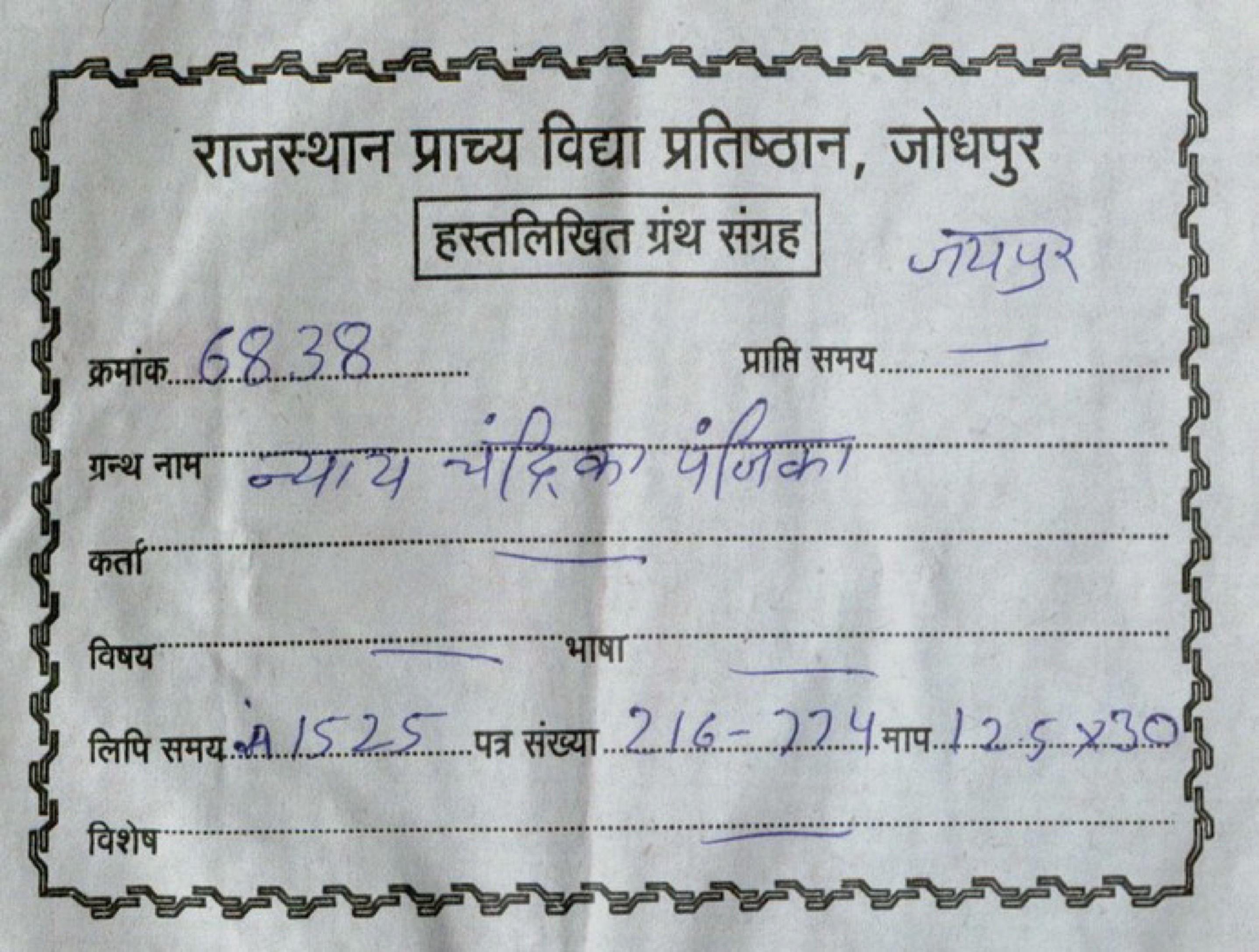
Title card for RORI 6838.
Contents and physical description
Contents, foliation, and sequence
The manuscript is incomplete and partly damaged, as discussed below. Its extant portion begins with Gayadāsa’s commentary on the opening of Sūtrasthāna 18 and continues to the end of the Śārīrasthāna, covering Sūtrasthāna 18–46, Nidānasthāna 1–16, and Śārīrasthāna 1–10.
The RORI catalogue lists the manuscript under serial number 3988. It gives the folio size as 30 × 13 cm and records a total of 774 folios. It states that folios 4–215 are missing, folio 287 occurs twice, and folios 656–665 are unnumbered. (Vinayasagar & Baldwa, 1948, pp. 444–445)
Catalogue entry for RORI 6838 (RORI catalogue, vol. XI, pp. 444–445).
The digital copy allows us to refine this description:
The manuscript did extend to folio 774. Although the foliation is lost from the final folio, the preceding folio is numbered 773.
As far as we can tell, the entire opening section, folios 1–215, is now missing.
Folios 656–665 were probably numbered originally. Their right margins, where the folio numbers would have appeared, have broken away.
Two consecutive folios are numbered 287. A second hand, possibly that of a cataloguer, has distinguished them as prathama and dvi. Both are in the correct order and transmit a continuous passage of Gayadāsa’s commentary on Sūtrasthāna 26.9–10.
The foliation from 216 to 774 accounts for 559 numbered folios. Since folio number 287 occurs twice, the physical bundle should contain 560 folios, or 1,120 folio sides. The digital copy, however, contains only 1,115 photographs of individual sides. This difference does not necessarily indicate that any complete folios are missing.
The physical bundle appears to be largely arranged in textual order, and the digital copy seems to reproduce this arrangement faithfully. The clear exception is a group of five photographed sides placed at the front of the bundle. These apparently represent three displaced folios: one contains the end of the Nidānasthāna and its final colophon, while the other two contain the beginning of the Śārīrasthāna. Their foliation is no longer preserved, and we therefore cannot assign them folio numbers with confidence.
Several unphotographed sides can be identified at transitions between sections. The side preceding the colophon to the Sūtrasthāna is numbered 562v, so the colophon must stand on 563r. Since the Nidānasthāna begins on 564v, 563v and 564r were not photographed. At the next transition, the colophon to the Nidānasthāna appears on a verso, and the Śārīrasthāna begins on the verso of the following folio. The intervening recto is absent from the group of photographs placed at the front of the bundle. These sides were probably blank or nearly blank, although the rectos may have contained section titles.
Together with the presumably blank verso of the final folio, this accounts for four of the five unphotographed sides implied by the photograph count. The location of the remaining side cannot yet be determined, but it probably represents another blank or nearly blank side omitted by the photographer. The photograph count therefore gives no reason to suppose that a complete folio is missing.
Layout, decoration, and scribal practices
The manuscript is written in a clear variety of Devanagari. Each side contains ten lines, with approximately 40–45 akṣaras per line.
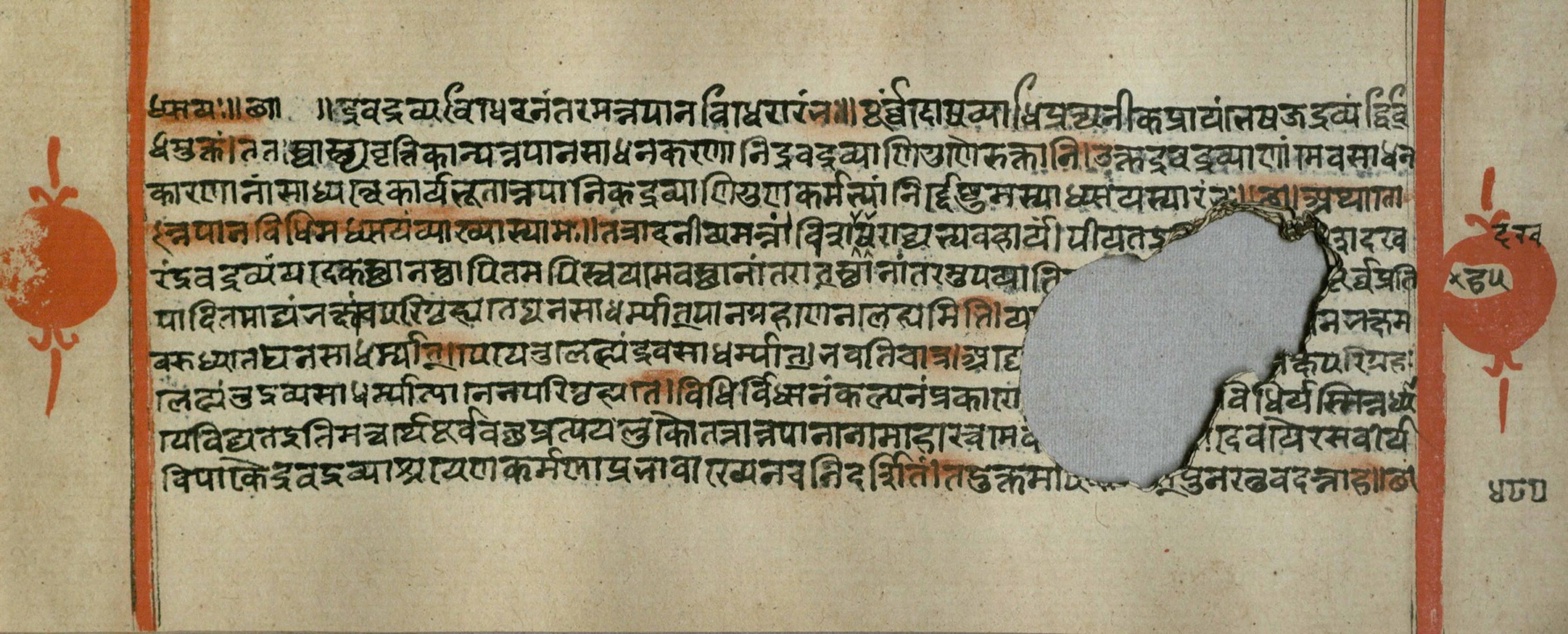
Most physical damage is confined to the margins and does not affect the text. The main exception is a large wormhole on the right side of folios 426–547. Its size varies, but at its largest it crosses seven lines and is approximately seven or eight akṣaras wide.
Straight orange-red lines mark the left and right edges of the writing area. Each verso also has an orange circle in both margins, occasionally expanded into a floral design. We have not yet identified a pattern governing the use of the more elaborate form.
The main foliation appears in the lower part of the right margin on each verso. The Nidānasthāna and Śārīrasthāna also have separate sectional foliations, each beginning with 1, at the bottom of the same margin. The right margins of the final Nidānasthāna folios are broken away, but the section appears to extend over approximately 100 folios. The Śārīrasthāna occupies 111 folios.
The manuscript is extensively rubricated in orange-red ink, although the purpose of every instance of rubrication is not yet clear. Identifiable examples include colophons, phrases introducing citations, and a red cha marking the beginning of a passage from the mūla.
Characteristic layout, rubrication, and worm damage in RORI 6838 (fol. 470v; beginning of the Nyāyacandrikā on SS 1.46).
Scribal colophons
In addition to the colophons marking the ends of individual chapters and sthānas, the manuscript preserves three longer scribal colophons: one each at the ends of the Sūtrasthāna, Nidānasthāna, and Śārīrasthāna. They provide valuable historical evidence about the manuscript’s production. I first present the three transcriptions with photographs and then discuss them together.
In the transcriptions, strikethrough reproduces text deleted by the scribe. Curly brackets { } enclose text removed by editorial emendation, while angle brackets ⟨ ⟩ contain editorial additions, replacements, or restorations. Thus, a replacement is written as {original}⟨emendation⟩. Superscript and subscript reproduce additions written above or below the line. A red dotted underline marks an uncertain reading, while a wavy underline marks a problematic form retained as written. Hyphens have been added editorially to mark boundaries within compounds and make the text easier to read.
Scribal colophon at the end of the Sūtrasthāna
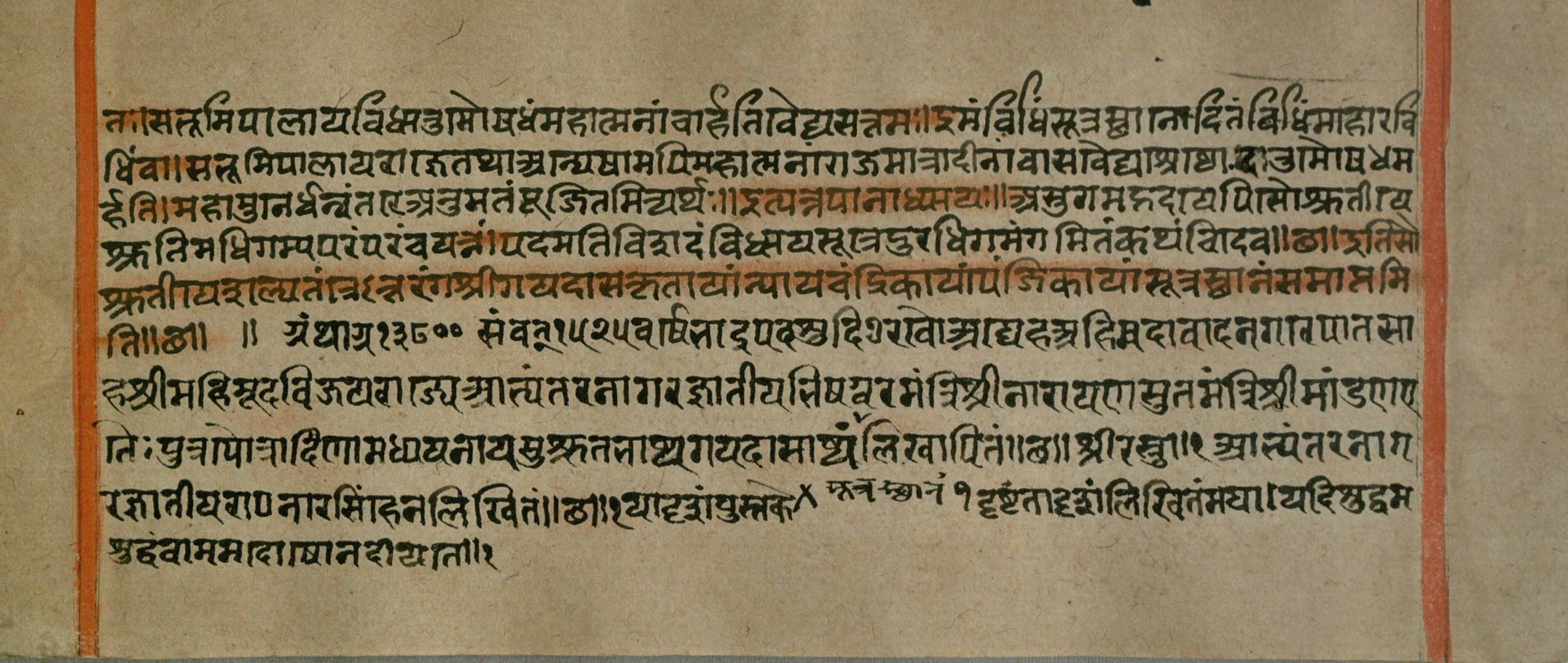
Scribal colophon at the end of the Sūtrasthāna (fol. 563r).
The right-hand margin has broken away, and part of the text is lost. Missing passages have been supplied from the parallel formulations in the other two colophons.
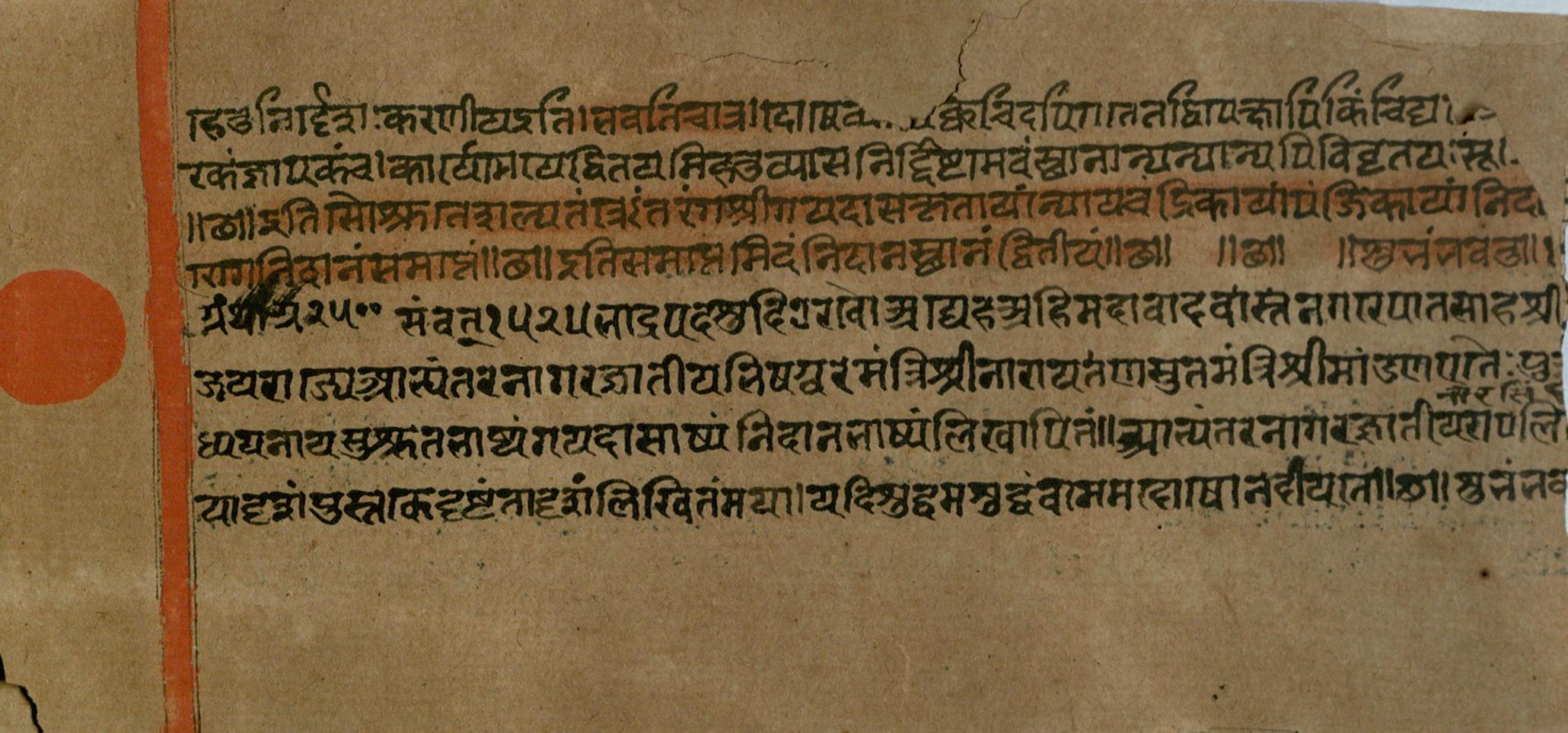
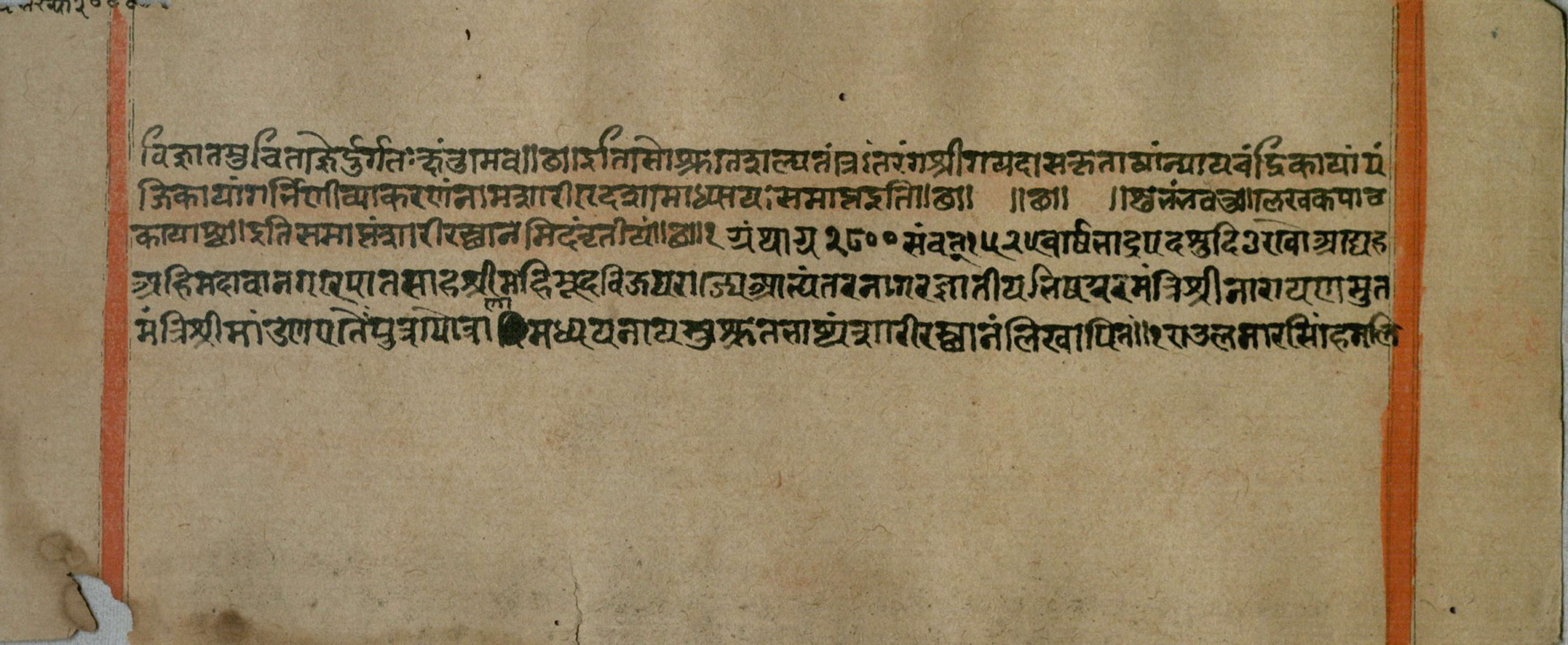
Scribal colophon at the end of the Nidānasthāna (folio number not preserved).
All three colophons contain substantially the same information. Their Sanskrit is compressed and often syntactically irregular, but their general meaning remains clear. As Nalini Balbir has shown in her study of Western Indian manuscript colophons (Balbir & Ciotti, 2022), these texts commonly follow a conventional sequence of elements even when their grammatical relationships are only loosely expressed. The colophons of RORI 6838 correspond closely to this pattern: they record the extent of the text, the date and place of copying, the reigning ruler, the commissioner and his family, the intended purpose of the copy, the scribe, and concluding benedictions or scribal formulas.
The following sense-based translation draws primarily on the fullest wording preserved at the end of the Sūtrasthāna. It smooths out the syntax and does not attempt to resolve every problematic reading.
The extent of the text is 13,800 granthas. In Vikrama Saṃvat 1525, on the seventh tithi of the bright half of Bhādrapada, a Sunday—today, here in the city of Ahmedabad, during the victorious reign of Sultan Śrī Maḥmūd—Minister Śrī Māṇḍaṇa, son of the eminent physician and minister Śrī Nārāyaṇa and a member of the Ābhyantara Nāgara community, caused Gayadāsa’s commentary on Suśruta, namely the Sūtrasthāna, to be copied for the study of his sons and grandsons. May there be good fortune. It was copied by Rā(ula) Nārasiṃha of the Ābhyantara Nāgara community.
“I copied it as I saw it in the exemplar. Whether correct or incorrect, no blame should be assigned to me.”
Extent of the sections
Each colophon begins by recording the extent of the preceding section: 13,800 granthas for the Sūtrasthāna, 2,500 for the Nidānasthāna, and 2,800 for the Śārīrasthāna. Here grantha is a conventional unit of thirty-two syllables rather than a verse or physical line.
Date and historical setting
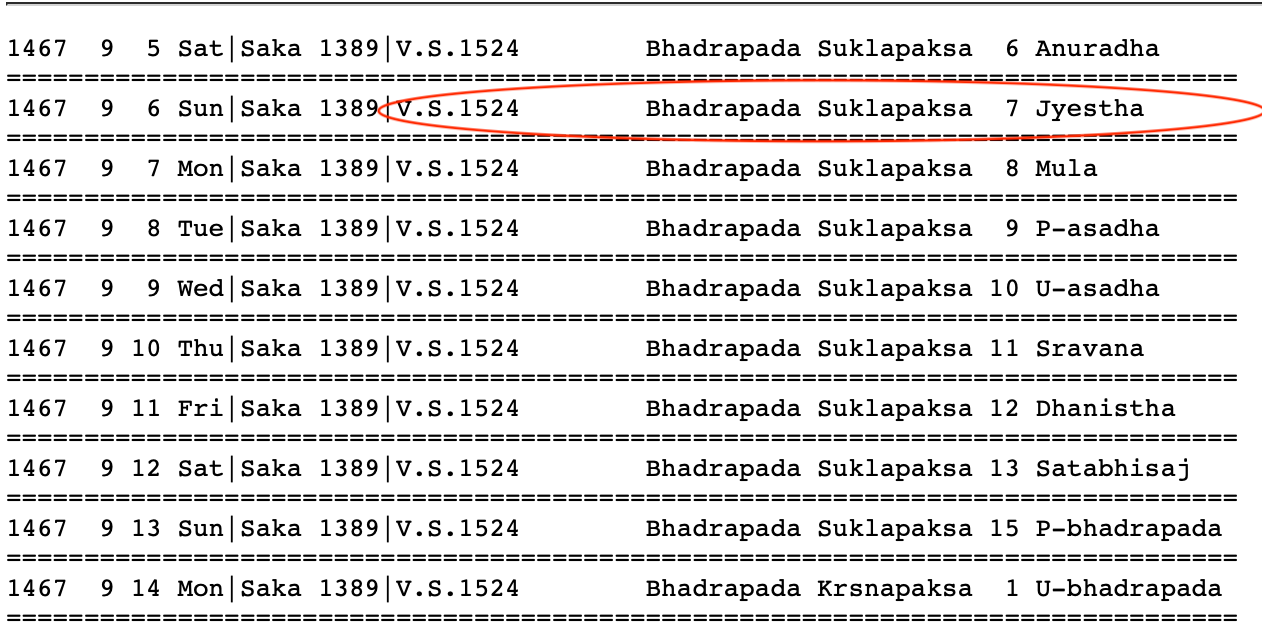
The three colophons give the same date for the commissioned copying of their respective sections: Vikrama Saṃvat 1525, the seventh tithi of the bright half of Bhādrapada, a Sunday. The weekday makes it possible to identify the date more precisely. Using M. Yano and M. Fushimi’s Pañcāṅga, I calculate the date as Sunday, 6 September 1467 in the Julian calendar, or 15 September 1467 in the proleptic Gregorian calendar. This calculation treats Vikrama Saṃvat 1525 as the current year, corresponding to 1524 elapsed years. It also follows Yano and Fushimi’s recommended procedure for handling the intercalary month (adhimāsa).
Pañcāṅga output for Sunday, 6 September 1467 (Julian): Bhādrapada śukla 7, VS 1524 elapsed.
The place is given as Ahmedabad (Ahimadāvāda). The ruler is named as Sultan Śrī Maḥmūd, in whose “victorious reign” (vijayarājya) the copying took place. Given the date, this can be identified with Maḥmūd I Begaḍā, Sultan of Gujarat from 1458 to 1511.1
Commissioner and intended readers
The commissioner was the minister Śrī Māṇḍaṇa, son of the eminent physician and minister Śrī Nārāyaṇa. The copy was intended for the study of Māṇḍaṇa’s sons and grandsons. The colophon thus places its production within a learned family whose members combined medical knowledge with administrative service.
Māṇḍaṇa and his father belonged to the Nāgara Brahmin community, which was closely associated with the intellectual and administrative life of Gujarat. The colophons use the more specific designation Ābhyantara Nāgara. Its exact significance remains unclear, although the same community is mentioned in several other manuscript colophons.2
The scribe
The scribe belonged to the same Ābhyantara Nāgara community. In the colophon to the Śārīrasthāna, his name is clearly written as Rāula Nārasiṃha, with Rāula most probably forming part of the personal name. The corresponding akṣaras in the other two colophons are less clear. A more confident reading may become possible as we gain greater familiarity with the handwriting of the manuscript.
The familiar formula following the scribe’s name states that he copied the text as he found it in his exemplar and should not be blamed for either correct or incorrect readings. It thus places responsibility for any errors on the manuscript from which he copied.
Difficult readings
Several expressions remain problematic. The plural instrumental etaiḥ, placed after Māṇḍaṇa’s name, does not fit the expected Sanskrit construction, although its intended function is clear: Māṇḍaṇa is the person who caused the manuscript to be copied.
The designation of the work is also uncertain. The manuscript reads forms such as suśrutabhāṣyaṃ gayadāsāṣyaṃ. The second expression could reflect gayadāsasya, “of Gayadāsa,” or, more likely, a corrupt gayadāsākhyaṃ, “called Gayadāsa.” The translation above therefore uses the neutral formulation “Gayadāsa’s commentary on Suśruta” without adopting either emendation.
RORI 6838 and RORI 5157
The colophons also allow us to identify RORI 6838 with RORI 5157, now held at the Rajasthan Oriental Research Institute in Bikaner. RORI 5157 transmits Gayadāsa’s commentary on the Kalpasthāna. Its scribal colophon closely matches those of RORI 6838: both manuscripts name the same commissioner and give the same date and place of copying. The identification is further supported by their common layout and decoration. The two shelfmarks therefore represent different surviving parts of the same original manuscript.
Scribal colophon at the end of the Kalpasthāna in RORI 5157.
Together, the two parts preserve the text from Sūtrasthāna 18 to the end of the Śārīrasthāna and the Kalpasthāna. The intervening Cikitsāsthāna and the subsequent Uttaratantra have not yet been located.
The Jaipur and Bikaner portions were probably once kept together as a single manuscript bundle. Their later separation, together with the loss of the Cikitsāsthāna and Uttaratantra, suggests that the manuscript may at some stage have been divided and handled in separate parts, perhaps to facilitate the study of individual sections. This remains a hypothesis, but it would help to explain the present distribution of its surviving portions.
References
Vinayasagar, M., & Baldwa, J. (Eds.). (1948). Catalogue of Sanskrit and Prakrit Manuscripts: Jaipur Collection, Part XI. Rajasthan Oriental Research Institute.
BibTeX
@book{vinayasagar1948,
  editor = {Vinayasagar, M. and Baldwa, Jamunalal},
  publisher = {Rajasthan Oriental Research Institute},
  title = {Catalogue of Sanskrit and Prakrit Manuscripts: Jaipur Collection, Part {XI}},
  year = {1948},
  address = {Jodhpur}
}
Balbir, N. (2022). On the Syntax of Colophons in Jain Palm-Leaf and Paper Manuscripts from Western India. In N. Balbir & G. Ciotti (Eds.), The Syntax of Colophons: A Comparative Study across Pothi Manuscripts (pp. 119–148). De Gruyter. https://doi.org/10.1515/9783110795271-004
@incollection{balbir2022a,
  author = {Balbir, Nalini},
  booktitle = {The Syntax of Colophons: A Comparative Study across Pothi Manuscripts},
  publisher = {De Gruyter},
  title = {On the Syntax of Colophons in {Jain} Palm-Leaf and Paper Manuscripts from Western {India}},
  year = {2022},
  address = {Berlin and Boston},
  editor = {Balbir, Nalini and Ciotti, Giovanni},
  pages = {119--148},
  doi = {10.1515/9783110795271-004}
}
Balbir, N., Sheth, K. V., Sheth, K. K., & Tripathi, C. Bh. (2006). Catalogue of the Jain Manuscripts of the British Library: Including the Holdings of the British Museum and the Victoria & Albert Museum. Volume II: Catalogue (Nos. 1–687). The British Library & The Institute of Jainology.
BibTeX
@book{balbir2006a,
  author = {Balbir, Nalini and Sheth, Kanhaiyalal V. and Sheth, Kalpana K. and Tripathi, Candrabhal Bh.},
  publisher = {The British Library \& The Institute of Jainology},
  title = {Catalogue of the {Jain} Manuscripts of the {British Library}: Including the Holdings of the {British Museum} and the {Victoria \& Albert Museum}. Volume {II}: Catalogue (Nos. 1--687)},
  year = {2006},
  address = {London}
}
Kapadia, A. (2013). The Last Cakravartin? The Gujarat Sultan as “Universal King” in Fifteenth-Century Sanskrit Poetry. The Medieval History Journal, 16(1), 63–88. https://doi.org/10.1177/097194581301600103
@article{kapadia2013,
  author = {Kapadia, Aparna},
  doi = {10.1177/097194581301600103},
  journal = {The Medieval History Journal},
  number = {1},
  pages = {63--88},
  title = {The Last Cakravartin? The {Gujarat} Sultan as ``Universal King'' in Fifteenth-Century {Sanskrit} Poetry},
  volume = {16},
  year = {2013}
}
Kapadia, A. (2018). In Praise of Kings: Rajputs, Sultans and Poets in Fifteenth-Century Gujarat. Cambridge University Press. https://doi.org/10.1017/9781316597477
@book{kapadia2018,
  author = {Kapadia, Aparna},
  publisher = {Cambridge University Press},
  title = {In Praise of Kings: Rajputs, Sultans and Poets in Fifteenth-Century {Gujarat}},
  year = {2018},
  address = {Cambridge},
  doi = {10.1017/9781316597477}
}
Kim, J.-S. (2021). Atharvavedasaṃhitā der Śaunakaśākhā: Eine neue Edition unter besonderer Berücksichtigung der Parallelstellen der Paippalādasaṃhitā. Universität Würzburg. https://doi.org/10.25972/OPUS-27703
@book{kim2021,
  author = {Kim, Jeong-Soo},
  publisher = {Universität Würzburg},
  title = {Atharvavedasaṃhitā der Śaunakaśākhā: Eine neue Edition unter besonderer Berücksichtigung der Parallelstellen der Paippalādasaṃhitā},
  year = {2021},
  address = {Würzburg},
  doi = {10.25972/OPUS-27703}
}
Obrock, L. (2018). Muslim Mahākāvyas: Sanskrit and Translation in the Sultanates. In T. Williams, A. Malhotra, & J. S. Hawley (Eds.), Text and Tradition in Early Modern North India (pp. 58–76). Oxford University Press. https://doi.org/10.1093/oso/9780199478866.003.0003
@incollection{obrock2018,
  author = {Obrock, Luther},
  booktitle = {Text and Tradition in Early Modern North {India}},
  publisher = {Oxford University Press},
  title = {Muslim Mahākāvyas: {Sanskrit} and Translation in the Sultanates},
  year = {2018},
  editor = {Williams, Tyler and Malhotra, Anshu and Hawley, John Stratton},
  pages = {58--76},
  doi = {10.1093/oso/9780199478866.003.0003}
}
Apart from being a key figure in the history of medieval Gujarat, Maḥmūd Begaḍā is the subject of a fascinating quasi-historical mahākāvya, the Rājavinodamahākāvya, by Udayarāja. See, for example, (Kapadia, 2013; Kapadia, 2018; Obrock, 2018). ↩
]]>Andrey KlebanovThe Suśruta Project - 2025 Annual Report on Technical Infrastructure2026-08-24T00:00:00+00:002026-08-24T00:00:00+00:00https://sushrutaproject2.github.io/blog/2026/susruta-project-2025-annual-reportPrepared from the public record of the GitHub organization sushrutaproject1, the project website sushrutaproject1.github.io, Zenodo, and the INDOLOGY mailing list. Covers activity from January 1 to December 31, 2025. Compiled by Claude AI.
Overview
2025 was a transition year for the Suśruta Project. It marked the formal close of “The Suśruta Project 1.0” (2020–2024) — the SSHRC-funded study of the palm-leaf manuscript MS Kathmandu KL 699 (878 CE) and related witnesses of the Suśrutasaṃhitā — and the launch of its successor, “The Compendium of Suśruta in Time and Space: Mapping a Medical Tradition” (2025–2029). Both phases are led by Dominik Wujastyk (University of Alberta).
Major achievements
New five-year grant secured. SSHRC awarded Insight Grant 435-2025-0604, funding “Mapping a Medical Tradition” from 2025 through 2029, based at the University of Alberta. This is the project’s principal 2025 milestone: it converts the completed Phase 1 diplomatic transcription work into a funded program of critical editions, translations, and comparative study of the text’s transmission across South Asia, China, and Southeast Asia. The successor project maintains its own site and GitHub presence at sushrutaproject2.github.io.
Phase 1 edition brought to completion and re-archived. On May 15, 2025 the Sushrutasamhita_Saktumiva1 repository (the critical edition and its apparatus) reached release v.6.1, “Completed IIIF pointers for all witnesses” — every manuscript witness in the edition now links live to its IIIF facsimile images. A companion release on May 8, 2025 triggered Zenodo archiving of the repository for long-term preservation. Separately, an earlier edition state (v.4.3, the completed meta-editing of the Sūtrasthāna) was re-archived on Zenodo on April 9, 2025 (DOI 10.5281/zenodo.15184815), noting eleven pull requests of translation and structural work behind that release.
Web infrastructure consolidated. In a message to the INDOLOGY list dated December 16, 2025, Wujastyk announced the reorganization of the project’s online presence: legacy content moved to sushrutaproject1.github.io (with a further simplification to sushrutaproject.github.io completed in early 2026), the old sushrutaproject.org domain now redirects to the new site, and the successor project’s material lives separately at sushrutaproject2.github.io. This tidied up several years of accumulated web infrastructure into a clear two-phase structure.
Continued editing and translation. Commit activity through the year shows steady, hands-on philological work rather than large batch imports: individual adhyāya (chapter) files were revised piece by piece — for example passages in Nidānasthāna, Cikitsāsthāna 4.4, and chapters such as 2.1, 3.1, 5.1, 5.8, and 6.65 — interspersed with translation-PDF regenerations, typo fixes, and footnotes (e.g., on the philosophical schools referenced in the text). A concentrated run of this work in early-to-mid December 2025 (at least 39 commits between December 4 and 22) followed what commit messages describe as project seminars and editing sessions. Collaborator Deepro Chakraborty contributed a cleanup of the Nidānasthāna text, merged via pull request #327 on December 20. Routine XML regeneration was handled by an automated “Wujastyk Bot” process rather than by hand.
Groundwork for a new presentation platform. A new repository, Sushrutasamhita_Saktumiva2, was created to present the same critical edition through “Saktumiva 2.0,” an updated version of the project’s custom manuscript-collation viewer — the beginning of a migration away from the original Saktumiva 1.0 interface.
Releases in 2025
Date
Repository
Tag
Note
May 8, 2025
Sushrutasamhita_Saktumiva1
6.1
Release to trigger Zenodo archiving
May 15, 2025
Sushrutasamhita_Saktumiva1
v.6.1
IIIF pointers completed for all manuscript witnesses
Apr 9, 2025 (Zenodo record date)
Sushrutasamhita_Saktumiva1
v.4.3
Re-archived on Zenodo; 11 PRs of translation/structural work
Repositories active during the year
The sushrutaproject1 organization currently comprises five public repositories: Sushrutasamhita_Saktumiva1 (the main critical edition, TEI XML/TeX), the new Sushrutasamhita_Saktumiva2 (edition on the updated platform), sushrutaproject1.github.io (the project website), and a .github profile repository. All of the recorded 2025 activity above falls within the first two.
A note on the data
This report draws on what GitHub’s public pages and unauthenticated API allow without login credentials. Release, Zenodo, and mailing-list dates are exact. Commit figures, however, are drawn from spot samples (a full quarter and a three-week December window) rather than a complete year-long count, because GitHub’s unauthenticated API rate limit was reached repeatedly during research and search/date-filtered pages are blocked to automated fetches by GitHub’s own robots.txt. The one complete quarter that could be checked (April–June 2025) recorded 20 commits. Issue and pull-request history for 2025 could not be reliably retrieved for the same reason; PR #327 (merged December 20, 2025) is the one confirmed by name. A GitHub-authenticated review — for instance by connecting a personal access token, or by reviewing the repositories’ Insights pages directly in a browser — would allow a complete count.
Outlook
With Phase 1 archived and consolidated, 2026 activity is likely to concentrate on the newly funded Mapping a Medical Tradition project (sushrutaproject2) and on finishing the migration of the edition to the Saktumiva 2.0 platform.
]]>Dominik Wujastyk and Claude AIThe Suśruta Project 2 - First Half-Year Report 20262026-08-24T00:00:00+00:002026-08-24T00:00:00+00:00https://sushrutaproject2.github.io/blog/2026/susruta-project2-H1-2026-reportJanuary–June 2026
“The Compendium of Suśruta in Time and Space: Mapping a Medical Tradition,” the SSHRC-funded successor to the original Suśruta Project, is now a year into its five-year term (2025–2029). The first half of 2026 was dominated by one connected strand of philological work: the recovery of Gayadāsa’s lost eleventh-century commentary on the Suśrutasaṃhitā, the Nyāyacandrikā, from its scattered and often damaged manuscript remains. Alongside this, the project identified new textual layers within the Suśrutasaṃhitā itself, published a collaborative edition with an outside scholar, put the standard 1938 printed edition online in a form linked to manuscript images, and opened a new institutional collaboration in India.
Reconstructing Gayadāsa’s lost commentary
Three posts this half-year form a single line of inquiry into Gayadāsa, a commentator active around 1000 CE in Bengal whose Nyāyacandrikā is, in the project’s words, “the oldest commentary for which we have any surviving manuscripts” on the Suśrutasaṃhitā — yet one that survives only in scattered fragments. An April post (“The Nyāyacandrikā of Gayadāsa and its Manuscripts”) maps what remains: a single witness for the Sūtrasthāna portion (MS Bikaner Anup 4389), Nidānasthāna material in Bikaner Anup 4390 plus two manuscripts in France, and Śārīrasthāna and Kalpasthāna sections preserved respectively in a Jaipur and a Bikaner manuscript both commissioned in 1468 CE. Of all this, only the Nidānasthāna commentary has ever been published, in 1938.
Two earlier posts work directly with this material. A February post on MS Bikaner Anup 4389 (Gayadāsa on Sūtrasthāna chapter 2) describes a manuscript in poor condition — frequent lacunae marked syllable-by-syllable with dashes, corruption in nearly every sentence, and heavy marginal correction — and reports a finding, credited to Jason Birch, that roughly 20% of Gayadāsa’s commentary parallels that of the later commentator Ḍalhaṇa (12th century), suggesting Ḍalhaṇa drew on Gayadāsa well beyond his explicit citations. A companion February post on MS Cambridge UL Add.2491 pursues one specific borrowing: Gayadāsa’s gloss on the Saṃhitā’s opening claim that Suśruta’s teaching was “as Dhanvantari declared.” Gayadāsa calls this a pratisaṃskartṛ-sūtram, “a statement of the reviser/editor” — a reading, again attributed to Jason Birch’s analysis, that Ḍalhaṇa appears to have absorbed into his own fourfold classification of textual statement-types, going on to identify the reviser as Nāgārjuna on grammatical grounds (the perfect-tense verb uvāca, “spoke,” conventionally marking an unwitnessed past event in Sanskrit). Taken together, these posts argue that Gayadāsa’s thought, though nearly lost, is partly recoverable at one remove through Ḍalhaṇa’s later borrowings, and that his testimony bears directly on the Suśrutasaṃhitā’s editorial history.
New textual layers in the Suśrutasaṃhitā
Two posts identify material that distinguishes the Nepalese manuscript tradition (the project’s primary witnesses) from the printed vulgate. An April post on oneiromancy (dream interpretation) in Sūtrasthāna 29 reports ten verses — numbered 1.29.71.add1–add10 in the digital edition — that appear in all three Nepalese witnesses immediately after verse 71 but are absent from the vulgate anywhere in the text; no parallel for them has yet been found elsewhere in Sanskrit literature. One of the ten (add2) refers to Dhanvantari in a role the post notes differs markedly from his role in the vulgate, adding a further data point to the Dhanvantari question raised in the Gayadāsa posts above. A June post (“The external opinions cited by the Suśrutasaṃhitā,” on the formula ity eke, “some say,” typically rebutted with tat tu na samyak, “but that is not correct”) argues in the other direction: these attributed-but-anonymous rebuttals appear inconsistently across manuscripts, turning up in the vulgate but often not in the older Nepalese copies, which the post reads as evidence of later editorial interpolation rather than original argument with contemporary rivals. Both posts treat manuscript disagreement as itself the evidence for the text’s layered history, rather than a problem to be edited away.
Infrastructure and dissemination
A June post announced that the 1938 printed (vulgate) edition of the Suśrutasaṃhitā is now available online section by section, with each portion of the mūla (base text, commentary excluded) linked to IIIF facsimile images of the original printed pages — extending to the standard edition the same image-linking already completed for the manuscript witnesses in 2025.
In January, the project reported a publication arising from its collaborations: Lisa A. Brooks’s article on leech therapy in the Suśrutasaṃhitā, in History of Science in South Asia, which edits and translates a “Nepalese version” of the leech chapter — drawing on the three Nepalese manuscripts, including the 878 CE palm-leaf witness — against the vulgate text with Ḍalhaṇa’s commentary, tracing roughly two millennia of medical engagement with leeches.
New collaboration
In February the project held a virtual meeting with the research group of Prof. Maneesh Singhal at AIIMS (All India Institute of Medical Sciences), which brings together surgeons, biotechnologists, and Ayurvedic physicians and is developing a government-funded museum of Suśruta-related surgical history, including reconstructed instruments. The two groups agreed to combine manuscript-based philology (Wujastyk’s team) with medical, surgical, and phytochemical expertise (Singhal’s team), with further meetings planned.
Looking ahead
Two posts published just after this period, in mid-July 2026, indicate where the work is heading next: one directly addresses the dating of the Suśrutasaṃhitā, and another documents the project’s early experiments using Claude as a research aid — both natural next chapters after a half-year spent recovering lost commentary and mapping textual strata.
]]>Dominik Wujastyk and Claude AIExperiments with Claude2026-07-17T00:00:00+00:002026-07-17T00:00:00+00:00https://sushrutaproject2.github.io/blog/2026/Claude-experimentsThere are 186 adhyāyas in the Suśrutasaṃhitā. Our project members have critically edited and translated about 23 of them. Clearly there is a lot still to do!
The chapters that have not been edited have been published online as collations. That means, we took one of the manuscript transcripts, often H, and cleaned it up in a very simple and generic manner, removing references to the actual manuscript text (deletions, insertions, errors). We called the resulting file a provisional edition. Saktumiva allows us to collate this provisional edition against the manuscript witnesses. Of course, the provisional, un-critically-edited edition will mostly agree with the witness (probably H) from which it was derived. Nevertheless, there is great value in this provisional edition. Even in such a crude form, it provides an excellent idea of what the Nepalese version of the Suśrutasaṃhitā says, and the collation information in the apparatus gives the reader the opportunity to think creatively about unresolved difficulties in the provisional edition.
I have been thinking recently about how to improve these provisional edition chapters. At the same time, I have been learning about the emerging capabilities of AI systems like Gemini, ChatGPT and Claude.
I decided to experiment with the following idea. Ask Claude to study the 23 critically edited chapters alongside the witnesses that underly them. Derive a set of rules or patterns that capture our editorial practices. Then read the remaining un-critically-edited chapters and apply those rules to them.
The preliminary results of Claude’s output for Suśrutasaṃhitā, Sūtrasthāna 6 (Ṛtucaryā) can be seen here:
This is just the start of exploring whether AI can do serious critical editing work that will help with Sanskrit manuscript traditions where there are very large texts, very high numbers of manuscripts, or both.
]]>Dominik WujastykOn the Date of the Suśrutasaṃhitā2026-07-17T00:00:00+00:002026-07-17T00:00:00+00:00https://sushrutaproject2.github.io/blog/2026/On-the-date-of-the-SusrutasamhitaThe date of the Suśrutasaṃhitā is not 600 BCE
The early scholar Rudolf Hoernle proposed that some concepts from the Suśruta-Saṃhitā could be found in the Śatapatha-Brāhmaṇa, which he dated to the 600 BCE (see below). Unfortunately, this date is repeated very often, even today, by scholars who are not familiar with the progress of scholarship on the history of medicine in India [e.g., just one example]. However, during the twentieth and twenty-first centuries, scholarship on the history of Indian medical literature has advanced substantially.
Summary of more recent scholarship
Reliable historical evidence has now accumulated showing that the Suśruta-saṃhitā is a work of several historical layers. The most detailed and extensive consideration of the date of the Suśrutasaṃhitā is that published by Meulenbeld in his History of Indian Medical Literature (1999–2002). He presented evidence to show that its composition may have begun in the last centuries BCE, but it was completed in its present form by another author who redacted its first five chapters and perhaps another who added the long, final section, the “Later Treatise” (Sanskrit Uttaratantra) which is more than a third of the work. It is likely that the Suśruta-saṃhitā was known to the scholar Dṛḍhabala, a contributor to the Carakasaṃhitā who wrote between the fourth and fifth centuries CE. Additionally, several ancient Indian authors used the name “Suśruta”, resulting in potential misattribution (Meulenbeld, 1999, pp. IA, 333–357). In his words:
It is likely that the Suśruta-saṃhitā was known to the scholar Dṛḍhabala (fl. 300–500 CE), which gives the latest date for the version of the work that has survived into the modern era (Meulenbeld, 1999, pp. IA, 203–389).
In the book Suśrutasaṃhitā - A Scientific Synopsis, published by the Indian National Science Academy, the historians of Indian science Ray, Gupta and Roy noted the following view, which is broadly the same as Meulenbeld’s:
“The Chronology Committee of the National Institute of Sciences of India (Proceedings, 1952),[9] was of the opinion that third to fourth centuries A. D. may be accepted as the date of the recension of the Suśruta Saṃhitā by Nāgārjuna, which formed the basis of Dallaṇa’s commentary.”
The above view remains the consensus amongst university scholars of the history of Indian medicine and Sanskrit literature.
Where Hoernle went wrong
The scholar Rudolf Hoernle (1841–1918) based his 1907 argument on the Śatapathabrāhmaṇa, a Vedic text from the mid-first-millennium BCE (Proferes, 2020). Hoernle argued that the authors of the Śatapathabrāhmaṇa, were aware of the Suśrutasaṃhitā’s doctrines, and therefore the Suśrutasaṃhitā should be dated based on the composition date of Śatapathabrāhmaṇa(Hoernle, 1907, pp. 8–10). The composition date of the Brāhmaṇa was itself unclear, added Hoernle, but he estimated it to be about the sixth century BCE. However, Hoernle’s view was rooted in the unexamined assumption that the ideas about the human skeleton in the Suśrutasaṃhitā preceded those of the Brāhmaṇa. Strangely, Hoernle seems never to have questioned this unwarranted and unargued assumption.
Hoernle’s date of 600 BCE for the Suśrutasaṃhitā was been robustly challenged by intervening scholarship over the last century and into the twenty-first century. The year after Hoernle’s book came out, his dating was trenchently criticised by A. B. Keith, the leading Brāhmaṇa scholar of the day (Keith, 1908, pp. 136–137). Hoernle pointed out that putting Suśruta before the Śatapathabrāhmaṇa was illogical:
But with much deference to Dr. Hoernle this is really to turn things upside down. (ibid., p. 137)
But further we must demur to the date assigned [by Hoernle] to Yājñavalkya and the Śatapatha Brāhmaņa. In the first place it may be pointed out that as a matter of fact none of the passages on which Dr. Hoernle relies come from the books (I - V) which Weber has shown are really Yãjñavalkyan. Two come from the later book, XII, and two from books VIII and X which recognise not Yãjñavalkya but Śãṇḍilya as the authority. This fact invalidates also Dr. Hoernle’s remark that Yājñavalkya was like Suśruta a native of Eastern India, and lessens the probability that a North-western authority like Śãṇḍilya should borrow from Suśruta the doctrine of the marrow-parts of bones. In the second place it is hardly satisfactory to date Yãjñavalkya by identifying the Ajātaśatru of the Brhadāraṇyaka Upaniṣad with the contemporary of Buddha, and so placing him in 500 BC [now revised to 400 BCE – Wujastyk]. (ibid., p. 138).
Further views on chronology
As mentioned above, scores of scholars have proposed hypotheses on the formation and dating of the Suśrutasaṃhitā, ranging from 2000 BCE to the sixth century CE. These views have been gathered and described by Meulenbeld in his History of Indian Medical Literature as outlined above (Meulenbeld, 1999, pp. IA, 341–346).
Central to the problem of chronology is the fact that the Suśrutasaṃhitā was the work of several hands. The internal tradition recorded in manuscript colophons and by medieval commentators makes clear that an old version of the Suśrutasaṃhitā consisted of sections 1-5, with the sixth part having been added by a later author. However, the oldest extant manuscripts include the sixth section, called “The Later Book” (Skt. Uttara-tantra). Early manuscript colophons refer to the whole work as “The Suśrutasaṃhitā together with the Uttara-tantra,” reinforcing the idea that they are a combined work. Thus, it does not make sense to speak of “the date of Suśruta.” Like “Hippocrates,” the name “Suśruta” refers to the work of many authors working over several centuries.
Authorship
Suśruta is named in the text of the Suśrutasaṃhitā as the author (Sūtrasthāna 1.12), and is presented in later manuscripts and printed editions as narrating the teaching of his guru, Divodāsa. Early Buddhist Jatakas mention a Divodāsa as a physician who lived and taught in ancient Kashi (Varanasi). The earliest known mentions of the name “Suśruta” firmly associated with the tradition of the Suśrutasaṃhitā are in the Bower Manuscript (sixth century CE), where Suśruta is listed as one of the ten sages residing in the Himalayas (Meulenbeld, 1999, pp. IIA, 3–12).
After a review of all past scholarship on the identity of Suśruta, Meulenbeld concluded that:
As is obvious from the foregoing, it is rather generally assumed that we owe the main part of the Suśrutasaṃhitā or an earlier version of it to a historical person called Suśruta. This assumption, however, is not based on uncontrovertible evidence and may be illusory. The text of the Suśrutasaṃhitā does not warrant that the one who composed it was a Suśruta. The structure oif the treatise shows without ambiguity that the author, who created a coherent whole out of earlier material, attributed the teachings incorporated in his work to Kāśirāja Divodāsa… (Meulenbeld, 1999, pp. IA, 342).
Chinese evidence
Recently, Lu has discussed the reception of the materials
of Suśrutasaṃhitā sūtrasthāna, chapter 29 by Chinese Buddhists, especially in
the work of the second- and third-century translators of Saṅgharakṣa’s
Yogācārabhūmi, An Shigao (ca. 148–180 CE) and Dharmarakṣa
(fl. 284 \CE) (Lu, 2025). As Lu says, “The Sanskrit text fixes the baseline
wording” of the Chinese translations (ibid., p. 2). This fixes the reception of the Suśrutasaṃhitā in China to the mid- to late second century.
References
Hoernle, A. F. R. (1907). Studies in the Medicine of Ancient India: Osteology or the Bones of the Human Body. Clarendon Press.
BibTeX
@book{hoer-1907,
  author = {Hoernle, A. F. Rudolf},
  publisher = {Clarendon Press},
  title = {Studies in the Medicine of Ancient {India}: Osteology or the Bones of the Human Body},
  year = {1907},
  address = {Oxford},
  annote = {Hist. of literature: pp.\,1--18 Reprinted Concept Publishing Co., New Delhi, 1984.},
  archiveprefix = {ark},
  creationdate = {2021-10-01T13:05:29},
  eprint = {ark:/13960/t1pg9cq8b},
  file = {:Hoernle, AFR/Hoernle_Osteology_1907.pdf:PDF},
  modificationdate = {2022-06-19T17:14:22},
  owner = {dom}
}
Keith, A. B. (1908). Zeitschrift Der Deutschen Morgenländischen Gesellschaft, 1(62), 134–139. https://www.jstor.org/stable/43367361
@review{keit-1908,
  author = {Keith, Arthur Berriedale},
  file = {:Keith, AB/1908 ZDMG review of Hoernle Osteology.pdf:PDF},
  journal = {Zeitschrift Der Deutschen Morgenländischen Gesellschaft},
  number = {62},
  pages = {134--139},
  related = {hoer-1907},
  relatedtype = {reviewof},
  url = {https://www.jstor.org/stable/43367361},
  volume = {1},
  year = {1908}
}
Lu, L. (2025). Translating Medicine Across Cultures: The Divergent Strategies of An Shigao and Dharmarakṣa in Introducing Indian Medical Concepts to China. Religions, 16(7), 844. https://doi.org/10/hbphm5
@article{lu-2025,
  author = {Lu, Lu},
  doi = {10/hbphm5},
  journal = {Religions},
  number = {7},
  pages = {844},
  title = {Translating Medicine Across Cultures: The Divergent Strategies of An Shigao and Dharmarakṣa in Introducing Indian Medical Concepts to China},
  volume = {16},
  year = {2025},
  issn = {2077-1444},
  month = jun,
  file = {:Lu, Lu/lu-2025 - Translating Medicine across Cultures_ th.pdf:PDF},
  publisher = {MDPI AG}
}
Meulenbeld, G. J. (1999). A History of Indian Medical Literature. E. Forsten. http://n2t.net/ark:/13960/t4qk6558q
@book{meul-hist,
  author = {Meulenbeld, Gerrit Jan},
  publisher = {E. Forsten},
  title = {A History of Indian Medical Literature},
  year = {1999},
  address = {Groningen},
  isbn = {9069801248},
  url = {http://n2t.net/ark:/13960/t4qk6558q},
  volumes = {5}
}
Proferes, T. (2020). Vedas and Brāhmaṇas. In K. A. Jacobsen (Ed.), Brill’s Encyclopedia of Hinduism Online. Brill & Walter de Gruyter GmbH. https://doi.org/10/hcbx4w
@incollection{prof-2020,
  author = {Proferes, Theodore},
  booktitle = {Brill’s Encyclopedia of Hinduism Online},
  publisher = {Brill \& Walter de Gruyter GmbH},
  title = {Vedas and Brāhmaṇas},
  year = {2020},
  address = {Leiden},
  editor = {Jacobsen, K. A.},
  doi = {10/hcbx4w}
}