A New Manuscript of Gayadāsa’s Nyāyacandrikā
Dr Harshal Bhatt, a long-term research associate of the Suśruta Project, recently conducted a research trip to Jaipur, where he obtained a digital copy of manuscript RORI 6838. Our team has only begun to examine this source, but it already appears exciting for two reasons. First, it preserves a substantial copy of Gayadāsa’s Nyāyacandrikā, extending from Sūtrasthāna 18 to the end of the Śārīrasthāna. Preliminary comparison suggests that its text is considerably better than that of the witnesses previously available for these sections. Second, it also transmits the mūla of the Suśrutasaṃhitā, with readings that differ from the vulgate, whose text appears largely to reflect the readings preferred by Ḍalhaṇa.
The significance of these textual features will become clearer as our work progresses. This post is limited to the manuscript as a physical and historical artifact: its extent, foliation, layout, state of preservation, and scribal colophons. It does not assess the text transmitted by the manuscript. That subject will be addressed separately once we have examined it more fully.

Contents and physical description
Contents, foliation, and sequence
The manuscript is incomplete and partly damaged, as discussed below. Its extant portion begins with Gayadāsa’s commentary on the opening of Sūtrasthāna 18 and continues to the end of the Śārīrasthāna, covering Sūtrasthāna 18–46, Nidānasthāna 1–16, and Śārīrasthāna 1–10.
The RORI catalogue lists the manuscript under serial number 3988. It gives the folio size as 30 × 13 cm and records a total of 774 folios. It states that folios 4–215 are missing, folio 287 occurs twice, and folios 656–665 are unnumbered. (Vinayasagar & Baldwa, 1948, pp. 444–445)

The digital copy allows us to refine this description:
- The manuscript did extend to folio 774. Although the foliation is lost from the final folio, the preceding folio is numbered 773.
- As far as we can tell, the entire opening section, folios 1–215, is now missing.
- Folios 656–665 were probably numbered originally. Their right margins, where the folio numbers would have appeared, have broken away.
- Two consecutive folios are numbered 287. A second hand, possibly that of a cataloguer, has distinguished them as prathama and dvi. Both are in the correct order and transmit a continuous passage of Gayadāsa’s commentary on Sūtrasthāna 26.9–10.
The foliation from 216 to 774 accounts for 559 numbered folios. Since folio number 287 occurs twice, the physical bundle should contain 560 folios, or 1,120 folio sides. The digital copy, however, contains only 1,115 photographs of individual sides. This difference does not necessarily indicate that any complete folios are missing.
The physical bundle appears to be largely arranged in textual order, and the digital copy seems to reproduce this arrangement faithfully. The clear exception is a group of five photographed sides placed at the front of the bundle. These apparently represent three displaced folios: one contains the end of the Nidānasthāna and its final colophon, while the other two contain the beginning of the Śārīrasthāna. Their foliation is no longer preserved, and we therefore cannot assign them folio numbers with confidence.
Several unphotographed sides can be identified at transitions between sections. The side preceding the colophon to the Sūtrasthāna is numbered 562v, so the colophon must stand on 563r. Since the Nidānasthāna begins on 564v, 563v and 564r were not photographed. At the next transition, the colophon to the Nidānasthāna appears on a verso, and the Śārīrasthāna begins on the verso of the following folio. The intervening recto is absent from the group of photographs placed at the front of the bundle. These sides were probably blank or nearly blank, although the rectos may have contained section titles.
Together with the presumably blank verso of the final folio, this accounts for four of the five unphotographed sides implied by the photograph count. The location of the remaining side cannot yet be determined, but it probably represents another blank or nearly blank side omitted by the photographer. The photograph count therefore gives no reason to suppose that a complete folio is missing.
Layout, decoration, and scribal practices
The manuscript is written in a clear variety of Devanagari. Each side contains ten lines, with approximately 40–45 akṣaras per line.
Most physical damage is confined to the margins and does not affect the text. The main exception is a large wormhole on the right side of folios 426–547. Its size varies, but at its largest it crosses seven lines and is approximately seven or eight akṣaras wide.
Straight orange-red lines mark the left and right edges of the writing area. Each verso also has an orange circle in both margins, occasionally expanded into a floral design. We have not yet identified a pattern governing the use of the more elaborate form.
The main foliation appears in the lower part of the right margin on each verso. The Nidānasthāna and Śārīrasthāna also have separate sectional foliations, each beginning with 1, at the bottom of the same margin. The right margins of the final Nidānasthāna folios are broken away, but the section appears to extend over approximately 100 folios. The Śārīrasthāna occupies 111 folios.
The manuscript is extensively rubricated in orange-red ink, although the purpose of every instance of rubrication is not yet clear. Identifiable examples include colophons, phrases introducing citations, and a red cha marking the beginning of a passage from the mūla.

Scribal colophons
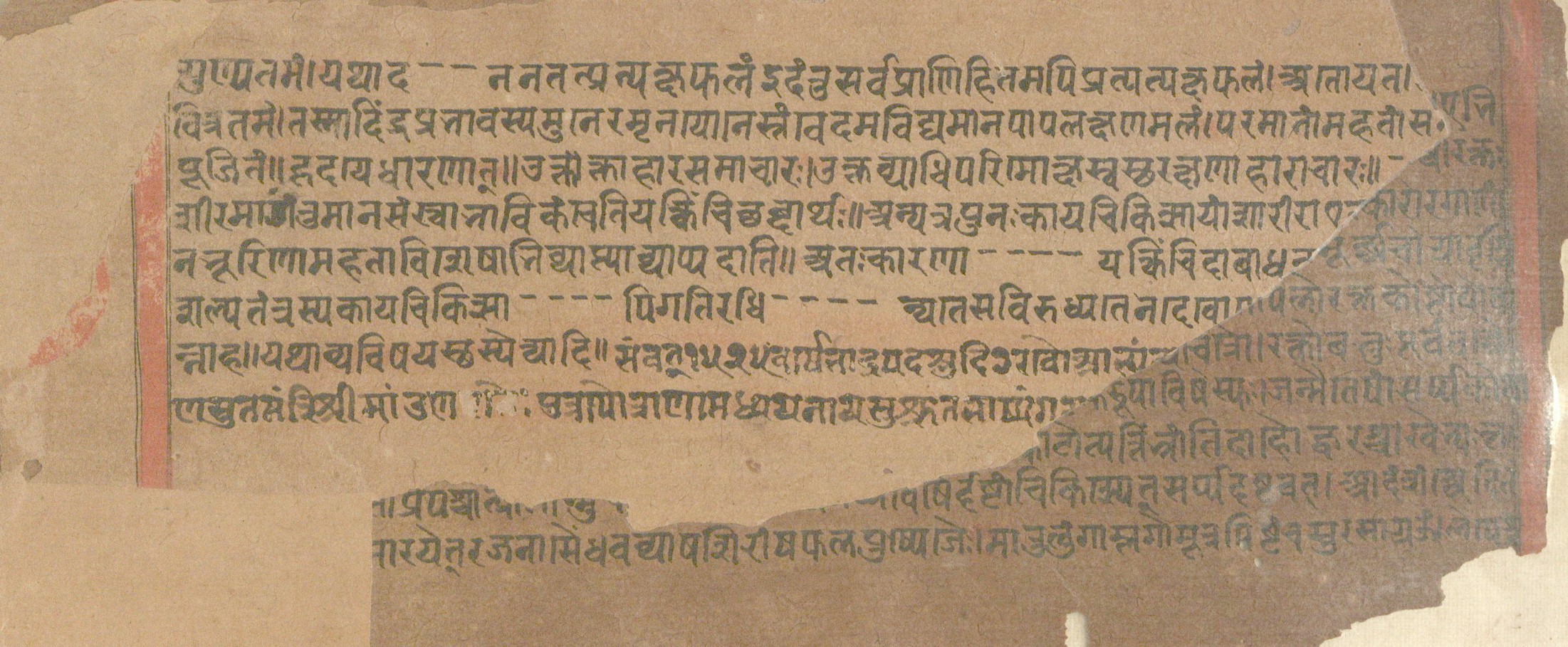
In addition to the colophons marking the ends of individual chapters and sthānas, the manuscript preserves three longer scribal colophons: one each at the ends of the Sūtrasthāna, Nidānasthāna, and Śārīrasthāna. They provide valuable historical evidence about the manuscript’s production. I first present the three transcriptions with photographs and then discuss them together.
In the transcriptions, strikethrough reproduces text deleted by the scribe. Curly brackets { } enclose text removed by editorial emendation, while angle brackets ⟨ ⟩ contain editorial additions, replacements, or restorations. Thus, a replacement is written as {original}⟨emendation⟩. Superscript and subscript reproduce additions written above or below the line. A red dotted underline marks an uncertain reading, while a wavy underline marks a problematic form retained as written. Hyphens have been added editorially to mark boundaries within compounds and make the text easier to read.
Scribal colophon at the end of the Sūtrasthāna

563r6ff.: granthāgra 13800 saṃvat 1525 varṣe bhādrapadaśudi 7 ravau adyeha ahimadāvādanagare pātasāha-ŚrīMahimūda-vijayarājye ābhyantaranāgarajñātīya-bhiṣagvara-maṃtri-ŚrīNārāyaṇa-suta-maṃtri-ŚrīMāṇḍaṇa-etaiḥ putrapautrā
dinām adhyayanāya suśrutabhā{ṣya}⟨ṣyaṃ⟩ gayadāsā{ṣ}⟨kh⟩yaṃ sūtrasthānaṃ likhāpitaṃ // cha // śrīr astu// ābhyantaranāgarajñātīya-Rātha-Nārasiṃhena likhitaṃ // cha // yādṛśaṃ pustake dṛṣṭaṃ tādṛśaṃ likhitaṃ mayā/ yadi śuddham aśuddhaṃ vā mama doṣo na dīyate//
Scribal colophon at the end of the Nidānasthāna
The right-hand margin has broken away, and part of the text is lost. Missing passages have been supplied from the parallel formulations in the other two colophons.

graṇthāgraṃ 2500 saṃvat 1525 bhādrapadaśudi 7 ravau adyeha ahimadāvāda
vāṃstaṃnagare pātasāha-Śrī⟨Mahimūda-vi⟩jayarājye ābhyaṃtaranāgarajñātīya-bhiṣagvara-maṃtri-ŚrīNārāyanaṇa-suta-maṃtri-ŚrīMāṃḍaṇa-etaiḥ putra⟨pautrādinām a⟩dhyāyanāya suśrutabhāṣyaṃ gayadāsā{ṣ}⟨kh⟩yaṃ nidānabhāṣyaṃ likhāpitaṃ/ ābhyantaranāgarajñātīya-rātha-narasiṃh⟨ena⟩li⟨khitaṃ /⟩ yādṛśaṃ pustake dṛṣṭaṃ tādṛśaṃ likhitaṃ mayā/ yadi śuddham aśuddhaṃ vā mama doṣo na dīyate// cha // śubhaṃ bhava⟨tu⟩
Scribal colophon at the end of the Śārīrasthāna

774r3: graṃthāgra 2800, saṃvat 1525 varṣe bhādrapadaśudi 7 ravau adyeha ahimadāvā⟨da⟩nagare pātasāha-ŚrīMahimūda-vijayarājye ābhyaṃtaranāgarajñātīya-bhiṣagvara-maṃtri-ŚrīNārāyaṇasuta-maṃtri-ŚrīMāṇḍana-etaiḥ putrapautrāṇām adhyayanāya suśrutabhāṣyaṃ śārīrasthānaṃ likhāpitam/1 rāulanārasiṃhena li
Reading the colophons
All three colophons contain substantially the same information. Their Sanskrit is compressed and often syntactically irregular, but their general meaning remains clear. As Nalini Balbir has shown in her study of Western Indian manuscript colophons (Balbir & Ciotti, 2022), these texts commonly follow a conventional sequence of elements even when their grammatical relationships are only loosely expressed. The colophons of RORI 6838 correspond closely to this pattern: they record the extent of the text, the date and place of copying, the reigning ruler, the commissioner and his family, the intended purpose of the copy, the scribe, and concluding benedictions or scribal formulas.
The following sense-based translation draws primarily on the fullest wording preserved at the end of the Sūtrasthāna. It smooths out the syntax and does not attempt to resolve every problematic reading.
The extent of the text is 13,800 granthas. In Vikrama Saṃvat 1525, on the seventh tithi of the bright half of Bhādrapada, a Sunday—today, here in the city of Ahmedabad, during the victorious reign of Sultan Śrī Maḥmūd—Minister Śrī Māṇḍaṇa, son of the eminent physician and minister Śrī Nārāyaṇa and a member of the Ābhyantara Nāgara community, caused Gayadāsa’s commentary on Suśruta, namely the Sūtrasthāna, to be copied for the study of his sons and grandsons. May there be good fortune. It was copied by Rā(ula) Nārasiṃha of the Ābhyantara Nāgara community.
“I copied it as I saw it in the exemplar. Whether correct or incorrect, no blame should be assigned to me.”
Extent of the sections
Each colophon begins by recording the extent of the preceding section: 13,800 granthas for the Sūtrasthāna, 2,500 for the Nidānasthāna, and 2,800 for the Śārīrasthāna. Here grantha is a conventional unit of thirty-two syllables rather than a verse or physical line.
Date and historical setting
The three colophons give the same date for the commissioned copying of their respective sections: Vikrama Saṃvat 1525, the seventh tithi of the bright half of Bhādrapada, a Sunday. The weekday makes it possible to identify the date more precisely. Using M. Yano and M. Fushimi’s Pañcāṅga, I calculate the date as Sunday, 6 September 1467 in the Julian calendar, or 15 September 1467 in the proleptic Gregorian calendar. This calculation treats Vikrama Saṃvat 1525 as the current year, corresponding to 1524 elapsed years. It also follows Yano and Fushimi’s recommended procedure for handling the intercalary month (adhimāsa).

The place is given as Ahmedabad (Ahimadāvāda). The ruler is named as Sultan Śrī Maḥmūd, in whose “victorious reign” (vijayarājya) the copying took place. Given the date, this can be identified with Maḥmūd I Begaḍā, Sultan of Gujarat from 1458 to 1511.1
Commissioner and intended readers
The commissioner was the minister Śrī Māṇḍaṇa, son of the eminent physician and minister Śrī Nārāyaṇa. The copy was intended for the study of Māṇḍaṇa’s sons and grandsons. The colophon thus places its production within a learned family whose members combined medical knowledge with administrative service.
Māṇḍaṇa and his father belonged to the Nāgara Brahmin community, which was closely associated with the intellectual and administrative life of Gujarat. The colophons use the more specific designation Ābhyantara Nāgara. Its exact significance remains unclear, although the same community is mentioned in several other manuscript colophons.2
The scribe
The scribe belonged to the same Ābhyantara Nāgara community. In the colophon to the Śārīrasthāna, his name is clearly written as Rāula Nārasiṃha, with Rāula most probably forming part of the personal name. The corresponding akṣaras in the other two colophons are less clear. A more confident reading may become possible as we gain greater familiarity with the handwriting of the manuscript.
The familiar formula following the scribe’s name states that he copied the text as he found it in his exemplar and should not be blamed for either correct or incorrect readings. It thus places responsibility for any errors on the manuscript from which he copied.
Difficult readings
Several expressions remain problematic. The plural instrumental etaiḥ, placed after Māṇḍaṇa’s name, does not fit the expected Sanskrit construction, although its intended function is clear: Māṇḍaṇa is the person who caused the manuscript to be copied.
The designation of the work is also uncertain. The manuscript reads forms such as suśrutabhāṣyaṃ gayadāsāṣyaṃ. The second expression could reflect gayadāsasya, “of Gayadāsa,” or, more likely, a corrupt gayadāsākhyaṃ, “called Gayadāsa.” The translation above therefore uses the neutral formulation “Gayadāsa’s commentary on Suśruta” without adopting either emendation.
RORI 6838 and RORI 5157
The colophons also allow us to identify RORI 6838 with RORI 5157, now held at the Rajasthan Oriental Research Institute in Bikaner. RORI 5157 transmits Gayadāsa’s commentary on the Kalpasthāna. Its scribal colophon closely matches those of RORI 6838: both manuscripts name the same commissioner and give the same date and place of copying. The identification is further supported by their common layout and decoration. The two shelfmarks therefore represent different surviving parts of the same original manuscript.
Together, the two parts preserve the text from Sūtrasthāna 18 to the end of the Śārīrasthāna and the Kalpasthāna. The intervening Cikitsāsthāna and the subsequent Uttaratantra have not yet been located.
The Jaipur and Bikaner portions were probably once kept together as a single manuscript bundle. Their later separation, together with the loss of the Cikitsāsthāna and Uttaratantra, suggests that the manuscript may at some stage have been divided and handled in separate parts, perhaps to facilitate the study of individual sections. This remains a hypothesis, but it would help to explain the present distribution of its surviving portions.
References
- Catalogue of Sanskrit and Prakrit Manuscripts: Jaipur Collection, Part XI1948
- On the Syntax of Colophons in Jain Palm-Leaf and Paper Manuscripts from Western IndiaIn The Syntax of Colophons: A Comparative Study across Pothi Manuscripts, 2022
- Catalogue of the Jain Manuscripts of the British Library: Including the Holdings of the British Museum and the Victoria & Albert Museum. Volume II: Catalogue (Nos. 1–687)2006
- The Last Cakravartin? The Gujarat Sultan as “Universal King” in Fifteenth-Century Sanskrit PoetryThe Medieval History Journal, 2013
-
- Atharvavedasaṃhitā der Śaunakaśākhā: Eine neue Edition unter besonderer Berücksichtigung der Parallelstellen der Paippalādasaṃhitā2021
- Muslim Mahākāvyas: Sanskrit and Translation in the SultanatesIn Text and Tradition in Early Modern North India, 2018
-
Apart from being a key figure in the history of medieval Gujarat, Maḥmūd Begaḍā is the subject of a fascinating quasi-historical mahākāvya, the Rājavinodamahākāvya, by Udayarāja. See, for example, (Kapadia, 2013; Kapadia, 2018; Obrock, 2018). ↩
-
See, for example, catalogue no. 82 in (Balbir et al., 2006, p. 62); Jaina Prosopography, which records four scribes belonging to this community; NGMCP MS A 353-8; and several Vedic manuscripts discussed by (Kim, 2021). ↩
Enjoy Reading This Article?
Here are some more articles you might like to read next: