 The museum building on the Amer Road, opposite the Jal Mahal. (Image: Museums of India.)
On Sunday, 11 October 2026, the two of us — Dominik Wujastyk and Jason Birch — made our first visit to the Shree Sanjay Sharma Museum and Research Institute in Jaipur. The museum stands on the Amer Road at Gujarghati, Parasrampuri, looking across the lake to the Jal Mahal. We came with two questions in mind: what manuscripts of the Suśrutasaṃhitā does the collection hold, and are there illustrated manuscripts on alchemy (rasaśāstra)?
We were warmly received by Chaitanya Sharma, grandson of the museum’s founder, Ram Kṛpālu Sharma, who took us through the galleries. Chaitanya’s father, Shri Tilak Sharma, the Director of the Museum, joined us later and the following day.
A collection that began with four manuscripts
The museum’s origins are literary. In the 1950s Ram Kṛpālu Sharma, who began his career as a schoolteacher, struggled to get his own writings published: a book of prose and verse, Prāñjali, appeared only after great difficulty, and a second, Vāṅmayī, never saw print for lack of funds. That experience led him, from 1955, to start collecting and preserving manuscripts — beginning with just four. The collection was first known as the Sharma Grantha Saṅgrahālaya. After the untimely death of his younger son, and Tilak’s brother, Sanjay Sharma, in 1982, it took its present name. With his wife Padmavati Sharma and the wider family, the founder went on to build the museum and library collections, and the institution remains a private, family-run foundation.
The family now describes the collection as numbering around a hundred thousand manuscripts, together with artefacts that illustrate their subjects. According to the Museums of India listing, the holdings span more than 200 subjects in some 16 languages and scripts — among them Brāhmī, Śāradā, Tibetan, Arabic, Persian, Tirhutā, Bengali, Telugu, Gujarati, Oriya, Gurmukhi and Devanāgarī — on palm leaf, birch bark and paper. Subject areas named include Vedic literature, jyotiṣa, tantra, dhanurveda, āyurveda and medicine, and “alchemy and chemistry”.
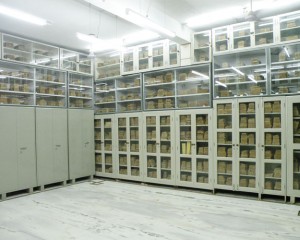 Manuscript cabinets in the library. (Image: Sanjay Sharma Museum.)
The galleries
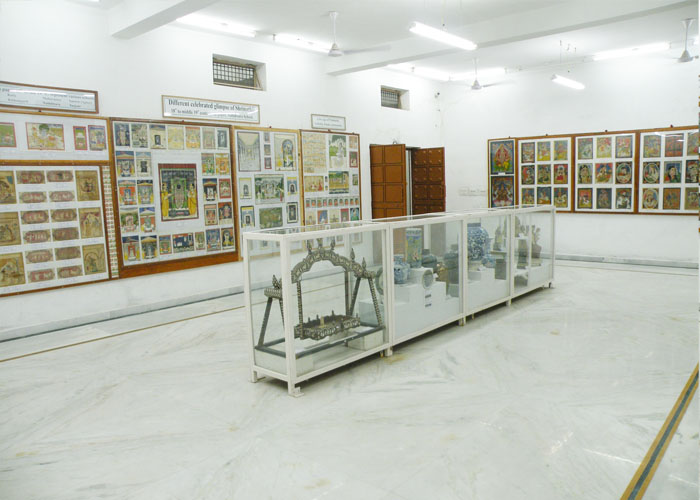 One of the painting galleries, with porcelain and a silver swing (hiṇḍolā) in the central case. (Image: Sanjay Sharma Museum.)
We were stunned by the extent and quality of the manuscripts, paintings and artifacts on display in the museum’s numerous spacious and marble-tiled galleries. Any visitor to Jaipur with an interest in Indian history and culture must not leave without a visit to this extraordinary collection.
The museum is laid out in several galleries: glass painting and porcelain; miniature painting (fifteenth to nineteenth centuries, from Jaipur, Kishangarh, Kota, Bundi, Bikaner, Nathdwara and elsewhere); textiles and costumes, largely from the Jaipur court; cloth paintings and picchvāīs; an art gallery; illustrated manuscripts; and the manuscript library itself.
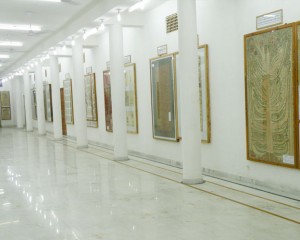 The long gallery of large cloth paintings. (Image: Sanjay Sharma Museum.)
 A Devanāgarī manuscript from Jaipur, dated 1588 CE. (Image: Museums of India.)
Among the illustrated material is a late nineteenth-century cosmological painting from Jaipur depicting the fourteen worlds (caturdaśabhuvana), from a series catalogued as the Viśvavijñāna-citrāvalī (1895). The tantra holdings include yantras such as an eighteenth-century Śani-yantra from Marwar.


In the Museum, photography is strictly prohibited, so we are unfortunately unable to illustrate any of the following remarks.
What we were looking for
The Suśrutasaṃhitā
As the Suśruta Project website explains, our project is focused on the textual and doctrinal differences between The Compendium as it existed in the earliest manuscript of 878 CE and the later “vulgate” version that was edited and reshaped by medieval commentators over the centuries. Manuscripts matter to the project, helping us to understand the history of this foundational work of medicine. We are trying to include as many manuscripts as possible in our research.
During our visit on 11 and 12 October, we saw a Suśrutasaṃhitā manuscript on display, but unfortunately we were not permitted to examine it. It is numbered MS Jaipur Sanjay Sharma Museum RN4MSS 4720. The single leaf on display had text that appeared to be a commentary on the main work, in a section about the Ayurvedic concept of “appropriateness” (Skt. sātmya). One passage cited the author Caraka. On the second day of our visit, Shri Tilak Sharma, the Museum’s Director, shared with us a photocopy of the last two folios of the manuscript. They showed it to be the ending of the last chapter of the Uttaratantra, with the final “Candraṭa” verse that we have discussed in another blog. We hope the Museum will see a way to share a digital image of the whole MS with us in due course.
Illustrated rasaśāstra
Professor Dagmar Wujastyk has been researching the history of Indian alchemy for several years. She has published several research articles on the history of rasaśāstra and on illustrated rasaśāstra manuscripts (Wujastyk, 2024). Her most recent book on the history of Indian alchemy was published by Oxford University Press in 2025 (Wujastyk, 2025). Professor Wujastyk had asked me to look out for illustrated alchemical manuscripts and I was delighted to see a richly illustrated copy of an unnamed alchemical rasaśāstra text in bhāṣā in one of the display cabinets. However, photography was not allowed and for the time being, since manuscripts are not being made available for study, research has to stop there.
Next steps
This was not my first visit to the Museum. In 2011, while working on the Vienna project on the Carakasaṃhitā, I visited the Museum in its former premises inside the Pink City. I went there to buy Ram Kṛpālu Sharma’s catalogue of the Museum’s Hindi manuscripts, a fine book with good illustrations. Shri Tilak Sharma kindly showed me some of the rooms that were then being reorganised, among them a room with fifteen to twenty almirahs (cupboards) full of manuscripts, two of them holding palm-leaf manuscripts alone. The collection was in the middle of a move, and there was as yet no way of searching it systematically. When I asked about manuscripts of the Carakasaṃhitā, I was assured that a collection of this size, one of the largest in India, would certainly contain them: Shri Ram Kṛpālu Sharma recalled one complete copy and several partial ones, probably of the eighteenth or nineteenth century. We parted on warm terms, having even discussed the idea of preparing, with Ram Kṛpālu Sharma and perhaps David White, a catalogue of the Museum’s richly illustrated rasaśāstra manuscripts. The Caraka Project came to an end some years ago and funding ended for the project, so the chance to collaborate with the Sanjay Sharma Museum remained unfulfilled.
Director Tilak Sharma said that there was no handlist of the 125,000 manuscripts in the collection, so it is difficult to know whether there are more copies of the Suśrutasaṃhitā, Rasaratnākara, or other interesting works in the collection. As in 2011, it seems very likely that the library holds a substantial body of Āyurvedic manuscripts, including copies of the Carakasaṃhitā and other classic works.
The Museum is negotiating with Gyan Bharatam, and it is to be hoped that a mutually beneficial MOU can be signed in the future that will help the library collection become accessible to research scholars.
Visiting
The museum is open daily from 9:00 am to 5:30 pm; allow one to two hours. Photography is not permitted inside. Contact details are on the museum’s website.
Sources
References
- Wujastyk, D. (Ed.). (2025). Indian Alchemy: Sources and Contexts. Oxford University Press. https://doi.org/10/hcpvqpDOI
BibTeX
@book{wujad-2025, editor = {Wujastyk, Dagmar}, publisher = {Oxford University Press}, title = {Indian Alchemy: Sources and Contexts}, year = {2025}, address = {New York}, isbn = {9780197805800}, month = aug, date = {2025}, doi = {10/hcpvqp} } - Wujastyk, D. (2024). The Forge and the Crucible. In P. A. Maas & A. Cerulli (Eds.), Suhṛdayasaṃhitā. A Compendium of Studies on South Asian Culture, Philosophy, and Religion. Dedicated to Dominik Wujastyk (pp. 127–163). Heidelberg Asian Studies Publishing. https://doi.org/10/hcpvqnDOI
BibTeX
@incollection{wujad-2024,
  author = {Wujastyk, Dagmar},
  booktitle = {Suhṛdayasaṃhitā. A Compendium of Studies on South Asian Culture, Philosophy, and Religion. Dedicated to Dominik Wujastyk},
  publisher = {Heidelberg Asian Studies Publishing},
  title = {The Forge and the Crucible},
  year = {2024},
  address = {Heidelberg},
  chapter = {5},
  editor = {Maas, Philipp A. and Cerulli, Anthony},
  pages = {127--163},
  doi = {10/hcpvqn}
}