In early October 2026 I visited the Āśā Saphū Kuthi in Kathmandu to look for manuscripts of the Suśrutasaṃhitā.
Finding the library
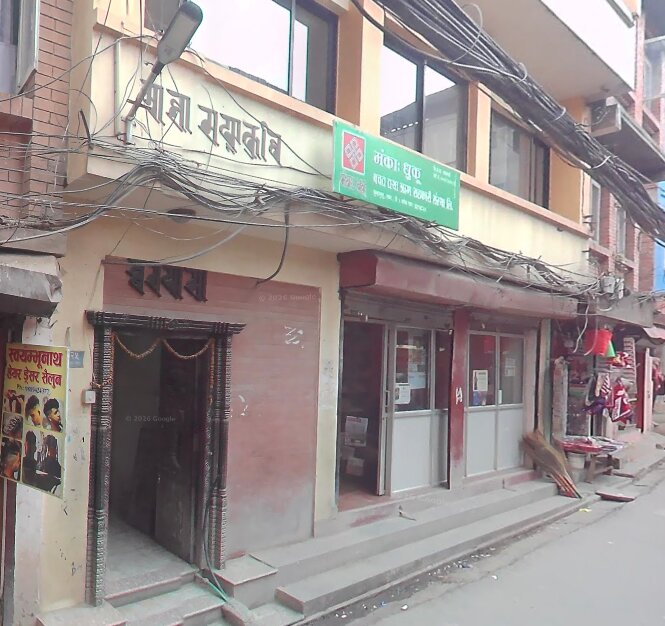
It is impossible to see the library building from the main road (Cittadhar Mārg), which is lined with two-storey shopfronts. Between two of the shops, a doorway with a carved wooden architrave opens onto a corridor that leads to a courtyard behind them. High above the doorway, and hard to see from street level, a sign in a Rañjanā script reads Āśā Saphūkuthi.
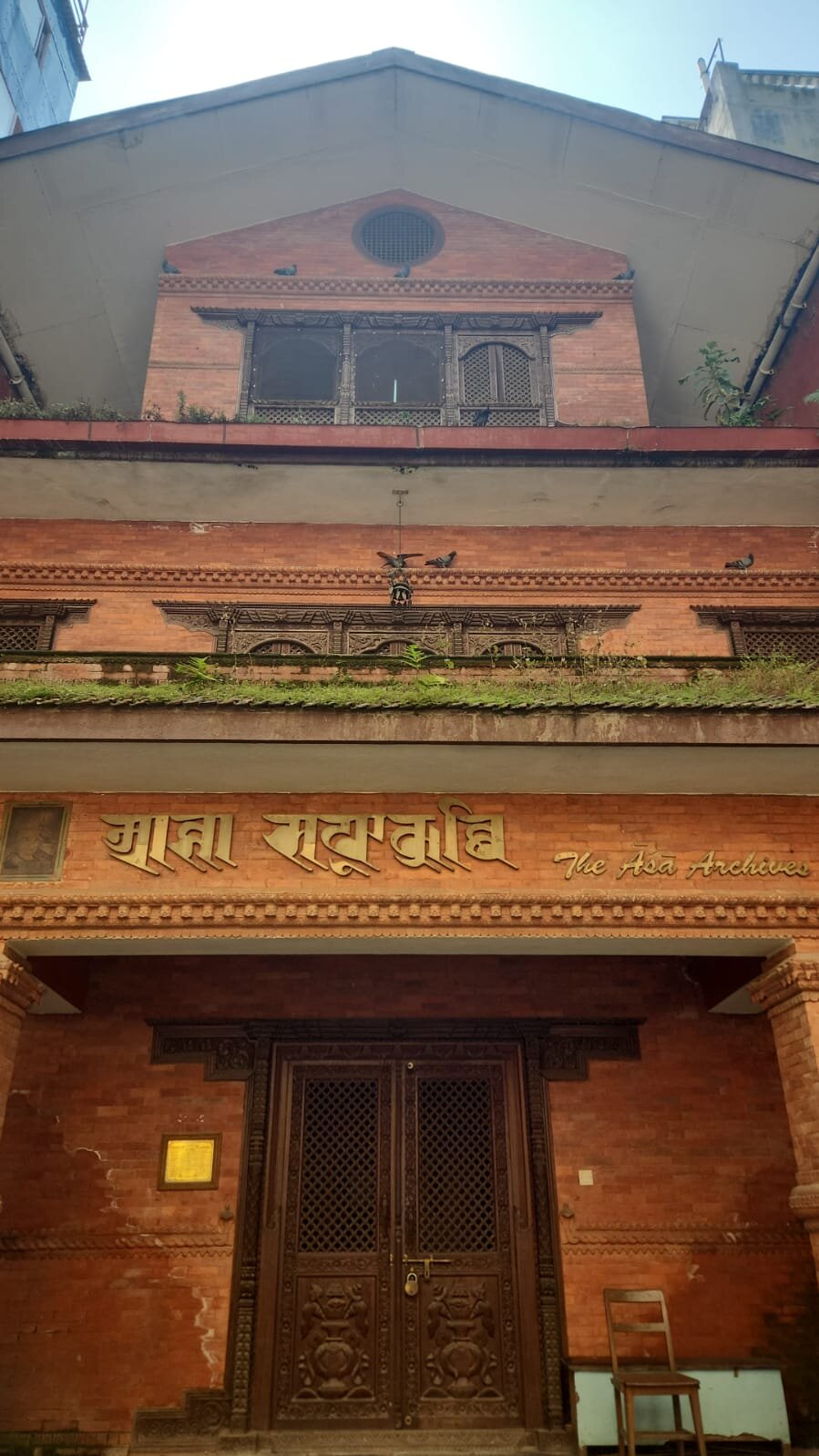
As one emerges from the corridor, a three-storeyed library building in traditional Newar style towers above. Over the porch the name is set in gilt letters, in the Nepāl script, with “The Āśā Archives” in English beside it.
A library for Nepāl Bhāṣā
The Āśā Saphū Kuthi (आशा सफू कुथि, “Āśā’s book house”), also called the Āśā Archives, is a free public library devoted to Nepāl Bhāṣā (Newar) books and manuscripts. It is located across the road (Cittadhar Mārg) from the Raktakālī temple.
As Rhishav Sapkota described (“The Life and Times of Asa Archives, a Nepal Bhasa Library,” 2021), it is named after Āśā Mān Siṃh Kansakar (1916–1990), who founded the Nepāl Bhāṣā publisher Cwāsā Pāsā in 1950. He hoped to create a “literary temple” where people could read Newar books. After seeing manuscripts sold to foreigners in Basantapur, he resolved that Nepal should keep its own. His son, the politician Prem Bahadur Kansakar, carried the project forward.
The core collection came from Prem Bahadur Kansakar and from the American scholar Ian Alsop, who gave almost 500 manuscripts to the elder Kansakar as gurudakṣiṇā. The present building was funded by the Toyota Foundation and inaugurated on 7 December 1987. A 16-member board of trustees governs the library, which runs on an endowment, fees and donations.
The collection, its catalogues and its digitization
The early collection holds over 7,000 manuscripts dating from the fifteenth to the nineteenth century. They are palm-leaf and paper pothīs, accordion books (Newar thyāsaphū), ritual handbooks and codices. The languages are Sanskrit, Nepāl Bhāṣā, Nepali, and mixtures of these. Subjects range across Hindu and Buddhist religion, poetics, astronomy, astrology and medicine. The upper floor also holds inscriptions, chronicles and about 1,200 palm-leaf land-grant documents.
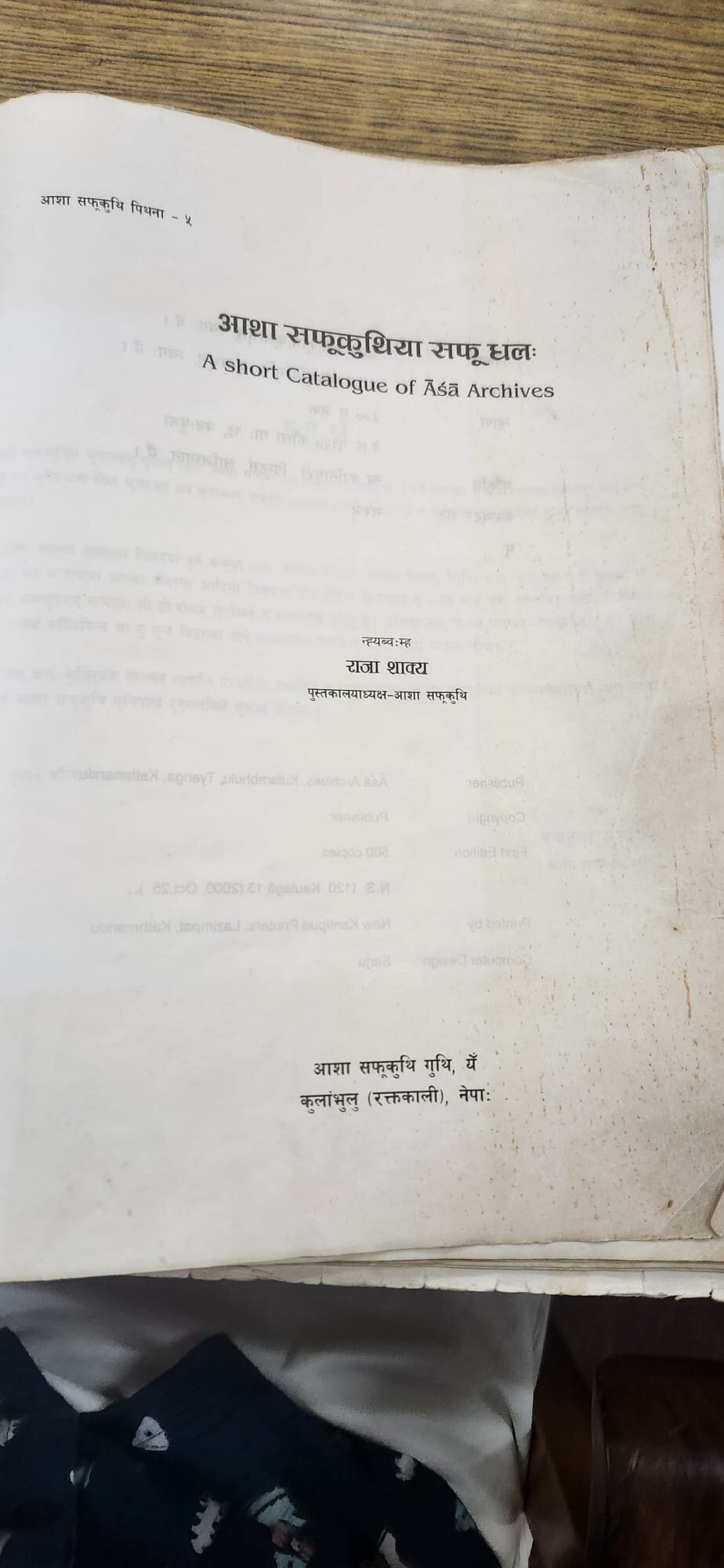
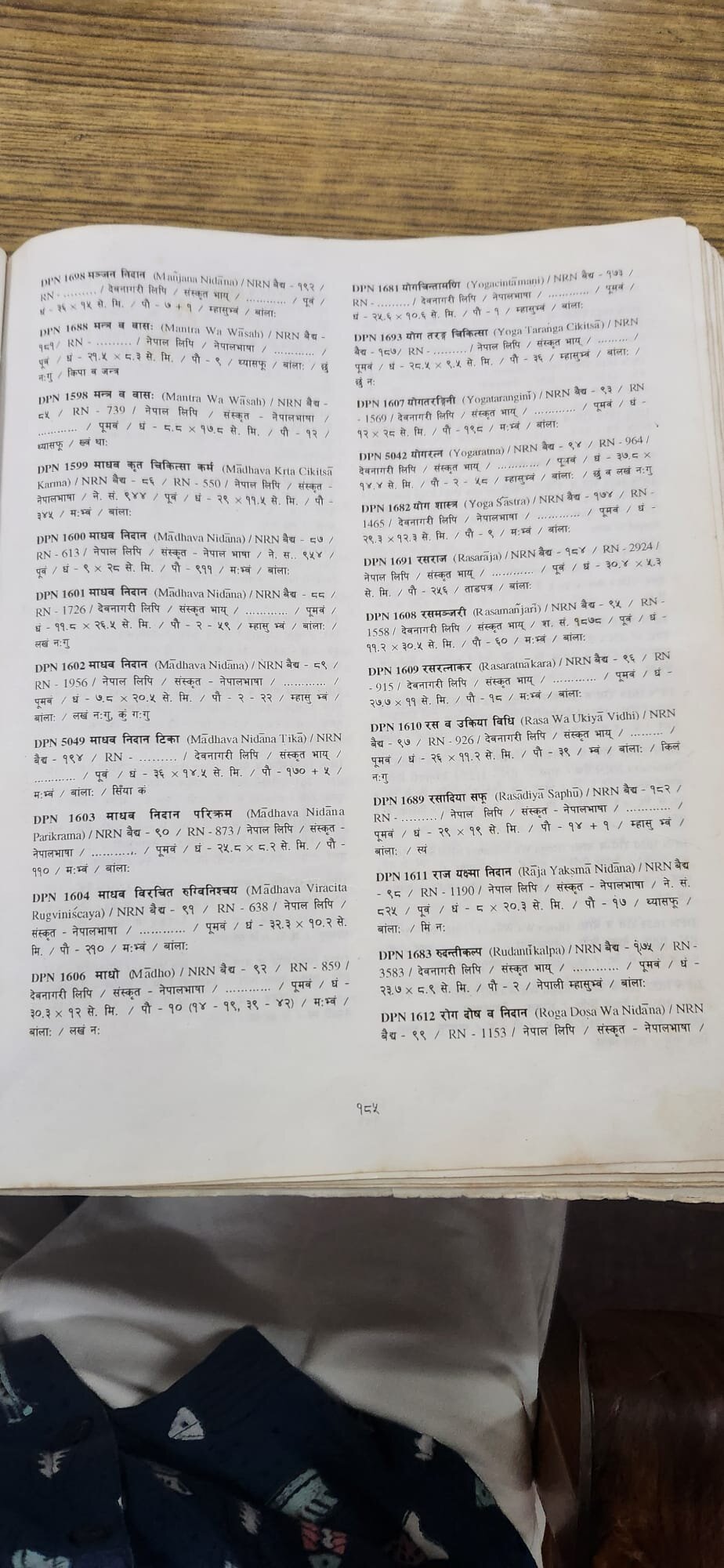
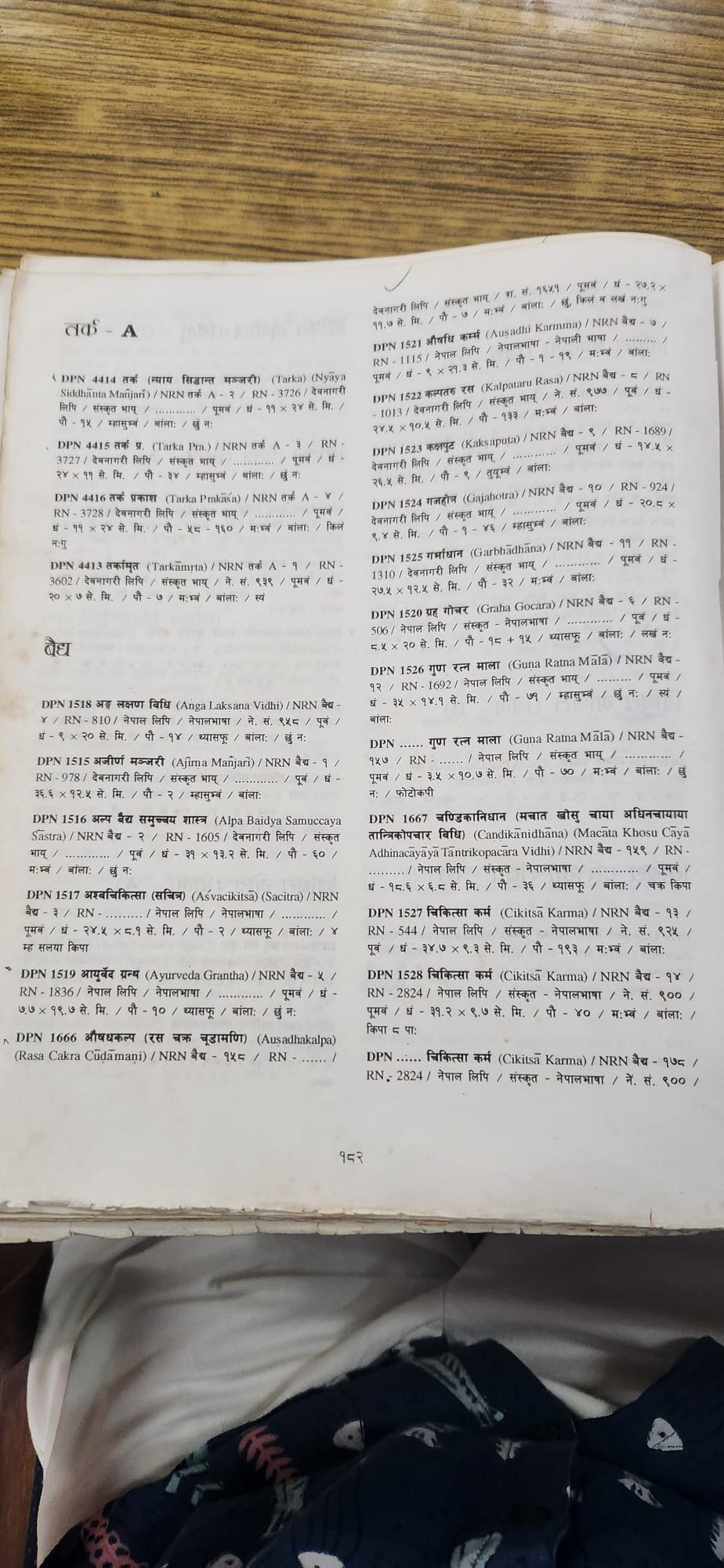
The assistant showed me the library’s printed catalogue, Āśā Saphūkuthiyā Saphū Dhalaḥ: A Short Catalogue of Āśā Archives (Āśā Saphūkuthi Pithanā 5), compiled by Rājā Śākya, then librarian, and published in N.S. 1120 (2000 CE) (Śākya, 2000). It is arranged by subject. Each entry gives a DPN5 number, title, script, language, date, completeness, size, number of folios and material. An earlier descriptive catalogue of the inscriptions and documents, by Janak Lal Vaidya and Prem Bahadur Kansakar, appeared in 1991 (Vaidya & Kansakar, 1991).
Digitization has come in several phases. In 1987 Shucho Takaoka led a first phase covering about 7,000 documents. From 2018 to 2022 the University of Hamburg’s Centre for the Study of Manuscript Cultures worked with the library on Preserving the Written Heritage of Nepal, coordinated by Bidur Bhattarai. Between 2019 and 2024 the Hill Museum & Manuscript Library (HMML) digitized 1,332 items from the “new collection”, dating from the seventeenth to the twentieth century, with funding from Arcadia, PHI and the NEH. These carry the project numbers DPN 07172–08121, the same DPN prefix that the printed catalogue uses. HMML has not yet catalogued them.
The medical manuscripts
The collection of medical works is fairly impressive. The medical (vaidya) section of the catalogue has nearly two hundred entries, many of them works in Nepāl Bhāṣā or bilingual Sanskrit–Nepāl Bhāṣā texts on diseases, diagnosis, pulse, remedies and mantras.
Among the Sanskrit works, two stand out: a complete manuscript of the relatively rare Mādhavacikitsā (DPN 1599), and an incomplete one of Ravigupta’s Siddhasāra (DPN 1660, chapters 1–8). There is also a damaged fragment of an illustrated work on horse medicine (aśvacikitsā) with four hand-painted illustrations of horses. A second veterinary text, a Śālihotra in Sanskrit and Maithilī, is also listed. Unfortunately for us, there were no Suśrutasaṃhitā manuscripts.
| DPN | Title in the catalogue | Script · language | Date | Folios | Notes |
|---|---|---|---|---|---|
| 1599 | Mādhava kṛta Cikitsā Karma | Nepāl · Sanskrit–Nepāl Bhāṣā | N.S. 844 (1723/24 CE) | 345 | Complete; 29 × 11.5 cm |
| 1660 | Siddhisāra Saṃhitā | Nepāl · Sanskrit | — | 34 | Incomplete; 22.5 × 9.7 cm |
| 1517 | Aśvacikitsā (sacitra) | Nepāl · Nepāl Bhāṣā | — | 2 | Accordion book; 4 paintings of horses |
| 1659 | Śālihotra | Nepāl · Sanskrit–Maithilī | — | 46 | Incomplete accordion book |
Details from Rājā Śākya’s Short Catalogue (2000), pp. 182–190.
Practical notes for visitors
The library opens at 11 am every day except Saturday. The front door is not locked but needs a good push; visitors who don’t know this may end up waiting outside, as I did, until someone who does arrives. In the morning the library is staffed by an assistant, who showed me the catalogue. The librarian does not arrive until after 3 pm, so my visit was punctuated by a long lunch at a nearby restaurant.
I got the impression that the whole manuscript collection has been digitised and is stored on hard drives in a locked cabinet. The librarian, who holds the key, did indeed arrive at 3 pm. She was very friendly and let me look at whatever manuscript scans I wanted. There is a fee of 100 NPR an hour to view the scans on the library’s computer. There is a photocopier; it is possible that digital images of manuscripts may be purchased, but I did not broach that topic.
For anyone working on Sanskrit or Newar medicine, the Āśā Saphū Kuthi repays the afternoon’s wait.
Web sources
- Āśā Saphūkuthi (DPN), Hill Museum & Manuscript Library
- Asa Safu Kuthi, Wikipedia
References
- Sapkota, R. (2021). The Life and Times of Asa Archives, a Nepal Bhasa Library. Nepal Live Today. https://web.archive.org/web/20251013063309/https://www.nepallivetoday.com/2021/08/11/the-life-and-times-of-asa-archives-a-nepal-bhasa-library/URL
BibTeX
@article{sapk-2021, creationdate = {2026-10-25T18:12:46}, modificationdate = {2026-10-25T18:14:47}, title = {The Life and Times of Asa Archives, a Nepal Bhasa Library}, author = {Sapkota, Rhishav}, year = {2021}, month = aug, date = {2021-08-11}, journal = {Nepal Live Today}, url = {https://web.archive.org/web/20251013063309/https://www.nepallivetoday.com/2021/08/11/the-life-and-times-of-asa-archives-a-nepal-bhasa-library/} } - Vaidya, J. L., & Kansakar, P. B. (1991). आशा सफू कुथिया अभिलेख ग्रन्थया वर्नात्मक धलः = A Descriptive Catalogue of Selected Manuscripts Preserved at the Āśā Saphū Kunthi (Āśā Archives). Cvasāpāsā, Kulāṃbhulu Raktakālī.ARK
BibTeX
@book{vaid-1991, creationdate = {2026-10-25T18:18:39}, author = {Vaidya, Janak Lal and Kansakar, Prem Bahadur}, modificationdate = {2026-10-25T18:52:03}, title = {आशा सफू कुथिया अभिलेख ग्रन्थया वर्नात्मक धलः = A Descriptive Catalogue of Selected Manuscripts Preserved at the Āśā Saphū Kunthi (Āśā Archives)}, year = {1991}, address = {Kathmandu}, eprint = {ark:/13960/s2p83gbvk4j}, eprinttype = {ark}, publisher = {Cvasāpāsā, Kulāṃbhulu Raktakālī} } - Śākya, R. (2000). आशा सफूकुथिया सफू धलः = A Short Catalogue of Āśā Archives (Issue 5).ARK
BibTeX
@book{saky-2000,
  creationdate = {2026-10-25T18:52:07},
  title = {आशा सफूकुथिया सफू धलः = A Short Catalogue of Āśā Archives},
  modificationdate = {2026-10-25T18:55:33},
  series = {Āśā Saphūkuthi Pithanā},
  number = {5},
  author = {Śākya, Rājā},
  year = {2000},
  eprint = {ark:/13960/s2b68nq1xr5},
  eprinttype = {ark}
}