Jejjaṭa
Related to the the problem of Candraṭa, we may note that manuscripts containing the “Candraṭa verse” that ends, “… आलोक्य जैज्जटीं ||” have sometimes been misinterpreted as containing a commentary by Jejjaṭa. This is the case, for example, with MS Bikaner Anup 4391, that was reported in this way in NCC (New Catalogus Catalogorum, An Alphabetical Register of Sanskrit and Allied Works and Authors, 2015, pp. 7: 317). This led Meulenbeld to assert the existence of a manuscript of a commentary by Jejjaṭa on the Suśrutasaṃhitā (Meulenbeld, 1999, pp. 1B 506 n.360). In fact, MS Bikaner Anup 4391 is the text of the Suśrutasaṃhitā, with the Candraṭa verse in the colophon. It is the same for MS London IOLR Taylor 1842: it is a manuscript supporting the Suśrutasaṃhitā with the commentary of Ḍalhaṇa, but nothing by the author Candraṭa.
MSS currently known to have the so-called Candraṭa verse:
- MS Bikaner Anup 4391
- MS London IOLR Taylor 1842 (Eggeling catalogue 2646)
- MS Kurukṣetra Jawaharlal Nehru Library 19786, f. 78v
- MS Los Angeles LACMA M.87.271c (ma-44977.tiff)
- MS Kolkata ASB G. 5275, part III (according to the catalogue)
- MS Udaipur RORI Udaipur coll. 1806(3)
- MS Jaipur Sanjay Sharma Museum RN4MSS 4720
Testimonia
There are also numerous statements in the secondary literature asserting that commentators cite Jejjaṭa’s commentary on the Suśrutasaṃhitā. For example, the NCC (idem) names Hemādri, Vijayarakṣita, Ṭoḍarānanda, Nāganātha, and Rūpanayana, to which Meulenbeld added Ḍalhaṇa, Gayadāsa and Niścalakara (ibid, v. 1A, p. 385). Some of these may indeed be concrete evidence for a commentary on the Suśrutasaṃhitā by Jejjaṭa. They need to be studied individually, especially those of Ḍalhaṇa and Niścalakara.
Indu’s commentary on the Aṣṭāṅgasaṅgraha
D. C. Bhattacharyya (Bhattacharyya, 1947, pp. 112, note 1) stated of Rudrapāraśara’s early edition of the Aṣṭāṅgasaṅgraha with the commentary Śaśilekhā by Indu (Rudrapāraśava, 1924), that,
The editor [Rudrapāraśara] had to rely on imperfect and fragmentary Mss. of the Śaśilekhā. But, … he filled up a lacuna in the Śaśilekhā with the text of the Nirantarapadī commentary (on Suśruta) by Jarjaṭa (vol. II, p. 298), which seems to be quite accessible to him, though it is a sealed book to the world outside. Many notes from Jarjaṭa [Jejjaṭa] have been printed in vols II and III.”
The passage on p. 298 of Rudrapāraśara’s edition reads as follows:
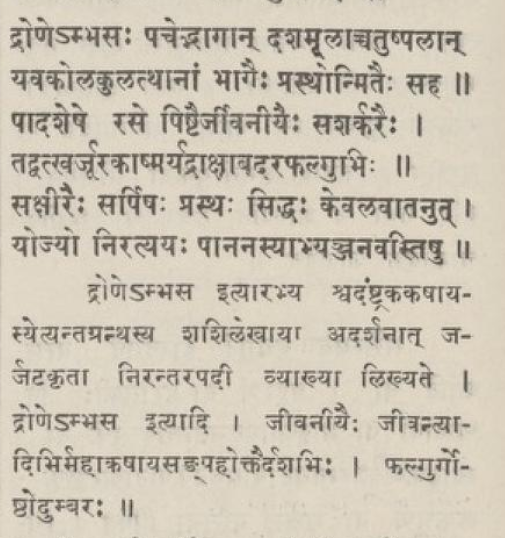
This is an interesting passage, but both of Bhattacharyya’s assertions about it are probably wrong. One has to ask, “whose voice is this commentarial statement?” It is impossible that Indu (fl. ca. 1000–1150) would have referred to his own commentary by name, saying that it was incomplete. It is also unlikely that it was Rudrapāraśara, in the 1920s. The passage is printed in the same size and font as the rest of the text of the Śaśilekhā. By contrast, p. 300 shows the typography of an editorial comment from Rudrapāraśara himself:
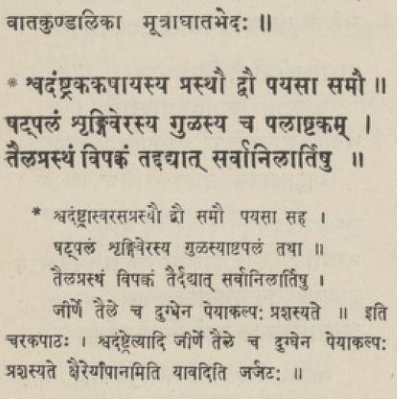
As suggested by Deepro Chakraborty (personal communication), it is more likely that the passage printed in the book is what Rudrapāraśara saw in his source, namely the manuscript of Indu’s commentary. Therefore, the comment would be that of a scribe who produced the manuscript that Rudrapāraśara was reading. This would be a scribal insertion, perhaps from the margin of the archetype of Rudrapāraśara’s manuscript, responding to physical damage to the manuscript, that had migrated into the body of the main text during the next copying. This is a common feature of manuscript transmission. It may be possible to check this, if one can find the manuscript from which Rudrapāraśara was working.
Regarding Bhattacharyya’s second assertion, there is nothing in this passage to suggest that Rudrapāraśara had access to a commentary by Jejjaṭa’s on the Suśrutasaṃhitā On the contrary, the name Nirantarapadī is an abbreviation of the name of Jejjaṭa’s commentary on the Carakasaṃhitā, i.e., “Nirantarapadavyākhyā” (Zysk & Yamashita, 2019; Sastry & Pandey, 1975). Further, on p. 300 (above) there is an explicit reference to the version of the passage under discussion as it appears in the text of the Carakasaṃhitā (चरकपाठे).
Other passages in the Śaśilekhā that require study because they refer to Jejjaṭa include Ni.2.3, Ci.9.50 and 51-52, Utt.30.79 and 80, 38.2-6a (Meulenbeld, 1999, pp. 1A: 670)
While I criticize Bhattacharyya’s assertions above, his 1947 paper was nevertheless a landmark contribution to medical history. He published much valid historical and prosopographical information for the first time through his extremely close reading of the sources.
A minor complicating factor is that the 1980 edition of the Aṣṭāṅgasaṅgraha edited by Āṭhavale prints the same passage word-for-word the same as in Rudrapāraśara’s edition (Āṭhavale, 1980, pp. 557–558). The most likely explanation is that Āṭhavale was simply reproducing Rudrapāraśara’s edition without thought at this point. (A print example of the scribal mechanism described above!) Āṭhavale was fully aware of the earlier edition and frames his own edition as being necessary because Rudrapāraśara’s edition had gone out of print. Only a fresh examination of the manuscripts will clear up this point.
In any case, those passages that I have examined from Indu on the Aṣṭāṅgasaṅgraha are from Jejjaṭa on the Carakasaṃhitā, not the Suśrutasaṃhitā. Further study is required to clarify and clarify this.
[Later edit:
Prof. Tsutomu Yamashita noted in an email (2025-09-06) that in his commentary on the Carakasaṃhitā, Jejjaṭa several times referred to the Suśrtasaṃhitā. The following passage illustrates such citations:
| Jejjaṭa on Caraka | Suśruta passage cited |
|---|---|
| Cikitsāsthāna 3 | Uttaratantra 39 |
| Cikitsāsthāna 24.199–205 | Uttaratantra 47.49 |
This internal evidence from Jejjaṭa’s own writing shows that he was certainly aware of the Suśrutasaṃhitā and referred to it. But this does not prove that he wrote a commentary on it.
At the time of writing, the fact that Ḍalhaṇa and others apparently cite Jejjaṭa while writing on the Suśrutasaṃhitā, and that Candraṭa said his revisions to the Suśrutasaṃhitā were made after studying Jejjaṭa, make it likely that there was once a commentary by Jejjaṭa on that text. However, the commentary is lost and the manuscripts that have been cited as containing parts of the commentary do not do so.
Ḍalhaṇa’s references to Jejjaṭa will be collected in a separate post.
References
- Bhattacharyya, D. C. (1947). Date and Works of Vāgbhaṭa the Physician. Annals of the Bhandarkar Oriental Research Institute, 28, 112–127. https://www.jstor.org/stable/44028048URL
BibTeX
@article{bhat-1947, author = {Bhattacharyya, Dinesh Chandra}, journal = {Annals of the Bhandarkar Oriental Research Institute}, pages = {112--127}, title = {Date and Works of {Vāgbhaṭa} the Physician}, url = {https://www.jstor.org/stable/44028048}, volume = {28}, year = {1947} } - Meulenbeld, G. J. (1999). A History of Indian Medical Literature. E. Forsten. http://n2t.net/ark:/13960/t4qk6558qURL
BibTeX
@book{meul-hist, author = {Meulenbeld, Gerrit Jan}, publisher = {E. Forsten}, title = {A History of Indian Medical Literature}, year = {1999}, address = {Groningen}, isbn = {9069801248}, url = {http://n2t.net/ark:/13960/t4qk6558q}, volumes = {5} } - Raghavan, V., Kunjunni Raja, K., Sundaram, C. S., Veezhinathan, N., Gangadharan, N., Rama Bai, E. R., Dash, S., & others. (2015). New Catalogus Catalogorum, An Alphabetical Register of Sanskrit and Allied Works and Authors. University of Madras. https://vmlt.in/ncc/URL
BibTeX
@book{ncc, author = {Raghavan, V. and {Kunjunni Raja}, K. and Sundaram, C. S. and Veezhinathan, N. and Gangadharan, N. and {Rama Bai}, E. R. and Dash, Siniruddha and others}, publisher = {University of Madras}, title = {New Catalogus Catalogorum, An Alphabetical Register of {Sanskrit} and Allied Works and Authors}, year = {2015}, address = {Madras}, series = {Madras University Sanskrit Series}, shorthand = {NCC}, url = {https://vmlt.in/ncc/}, volumes = {42} } - Rudrapāraśava, Ṭi. (1924). Aṣṭāṅgasaṅgrahaḥ Induvyākhyāsahitaḥ. The Mangalodayam Press. http://n2t.net/ark:/13960/t4cp9zt5cURL
BibTeX
@book{rudr-1924, author = {Rudrapāraśava, Ṭi.}, publisher = {The Mangalodayam Press}, title = {Aṣṭāṅgasaṅgrahaḥ Induvyākhyāsahitaḥ}, year = {1924}, address = {Trichur}, url = {http://n2t.net/ark:/13960/t4cp9zt5c}, volumes = {3} } - Sastry, V. V. S., & Pandey, A. N. (1975). Jajjata. Bulletin of the Indian Institute for History of Medicine, 5, 115–122. http://ccras.nic.in/sites/default/files/viewpdf/jimh/BIIHM_1975/115 to 122.pdfURL
BibTeX
@article{sast-1975, author = {Sastry, V. V. S. and Pandey, A. N.}, journal = {Bulletin of the Indian Institute for History of Medicine}, pages = {115--122}, title = {Jajjata}, url = {http://ccras.nic.in/sites/default/files/viewpdf/jimh/BIIHM_1975/115 to 122.pdf}, urldate = {2021-02-26}, volume = {5}, year = {1975} } - Zysk, K. G., & Yamashita, T. (2019). Sanskrit Medical Scholasticism – Jajjaṭa’s Nirantarapadavyākhyā and Other Commentaries on the Carakasaṃhitā, Cikitsāsthāna 2.1. eJIM: eJournal of Indian Medicine, 10(1), 1. https://doi.org/10.21827/5c3f01174756cDOI
BibTeX
@article{zysk-2019, author = {Zysk, Kenneth G. and Yamashita, Tsutomu}, doi = {10.21827/5c3f01174756c}, journal = {eJIM: eJournal of Indian Medicine}, number = {1}, pages = {1}, title = {Sanskrit Medical Scholasticism -- Jajjaṭa's Nirantarapadavyākhyā and Other Commentaries on the Carakasaṃhitā, Cikitsāsthāna 2.1}, volume = {10}, year = {2019}, publisher = {University of Groningen Press} } - Āṭhavale, A. D. (1980). Aṣṭāṅgasaṅgrahaḥ. Śrīmad Vṛddhavāgbhaṭaviracitaḥ Induvyākhyāsahitaḥ. Maheśa Anaṃta Āṭhavale, Śrīmad Ātreya Prakāśanam.ARK
BibTeX
@book{atha-1980,
  author = {Āṭhavale, Anaṃta Dāmodara},
  publisher = {Maheśa Anaṃta Āṭhavale, Śrīmad Ātreya Prakāśanam},
  title = {Aṣṭāṅgasaṅgrahaḥ. {Ś}rīmad Vṛddhavāgbhaṭaviracitaḥ Induvyākhyāsahitaḥ},
  year = {1980},
  address = {Puṇe},
  eprint = {http://n2t.net/ark:/13960/t9773bb9z}
}